




---
title: "How to Create Category Grid in Elementor?"
url: https://theplusaddons.com/docs/create-category-grid-in-elementor/
date: 2025-01-09
modified: 2026-09-27
lang: en
author: "Aditya Sharma"
description: "A grid is the most common way to showcase categories - even rows and columns that readers can scan quickly. The Dynamic Categories widget's Grid layout is its default, and..."
image: https://theplusaddons.com/wp-content/uploads/2025/01/How-to-Create-Category-Grid-in-Elementor_-1024x536.jpg
word_count: 215
---

# How to Create Category Grid in Elementor?

## 

- Dynamic Categories uses Grid as its default layout and displays terms in a responsive column grid.
- The Plus Addons for Elementor includes Dynamic Categories as a free widget, and it works with just The Plus Addons for Elementor installed, with no Pro licence required.
- Columns Manage sets independent column counts for Desktop 3, Tablet 4, and Mobile 6, plus a Columns Gap between grid items.

A grid is the most common way to showcase categories - even rows and columns that readers can scan quickly.

The **Dynamic Categories** widget's **Grid** layout is its default, and lays out terms in a responsive column grid.

***Requirement - This widget is a part of The Plus Addons for Elementor, make sure it's installed & activated to enjoy all its powers.***

[LIVE WIDGET LINK](https://theplusaddons.com/elementor-listing/dynamic-category/?utm_source=tpae&utm_medium=docs&utm_campaign=text)

## Before You Start

- **Prerequisite:** [Elementor](https://wordpress.org/plugins/elementor/) (free) installed and active.- **Edition:** Dynamic Categories is a **free** widget - it works with just The Plus Addons for Elementor installed, no Pro licence required.- **Widget to enable:** go to **The Plus Addons > Widgets**, search for **Dynamic Categories** and turn its toggle on.

## Steps

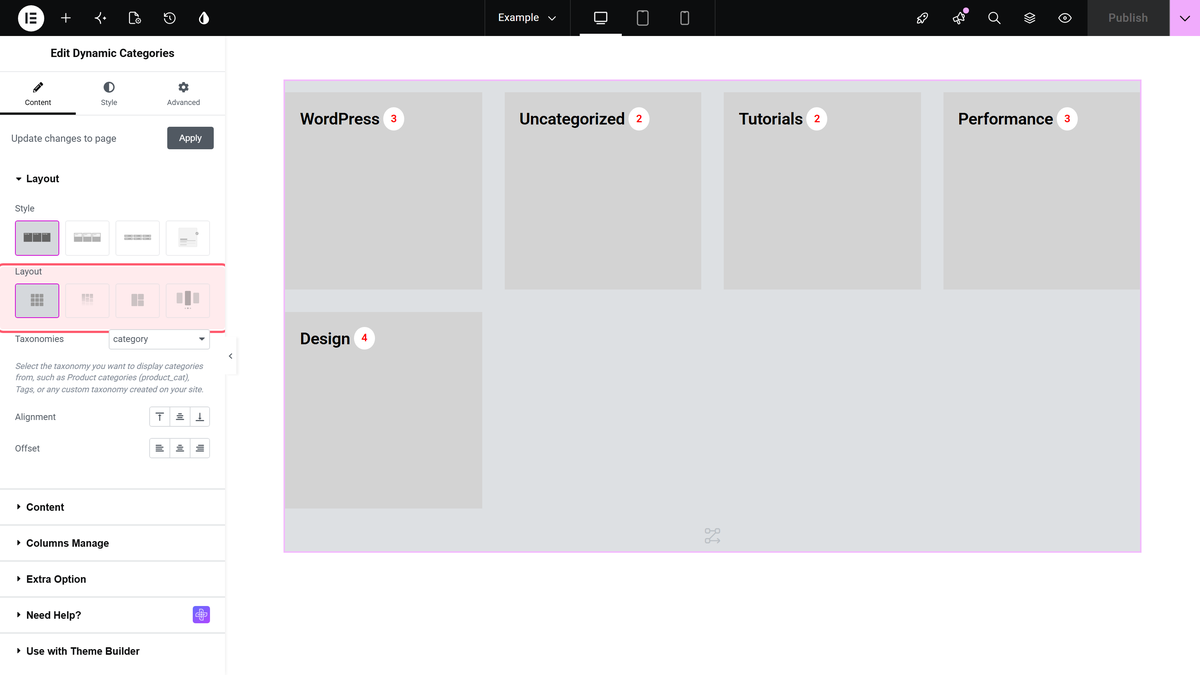
- Add the **Dynamic Categories** widget to the page.- From **Layout**, leave (or set) it to **Grid** - the default.- Choose which **Taxonomies** to list, if not the default Category.

![Layout set to Grid](https://theplusaddons.com/wp-content/uploads/2026/09/dynamic-categories-layout-grid.webp)

## Column Counts

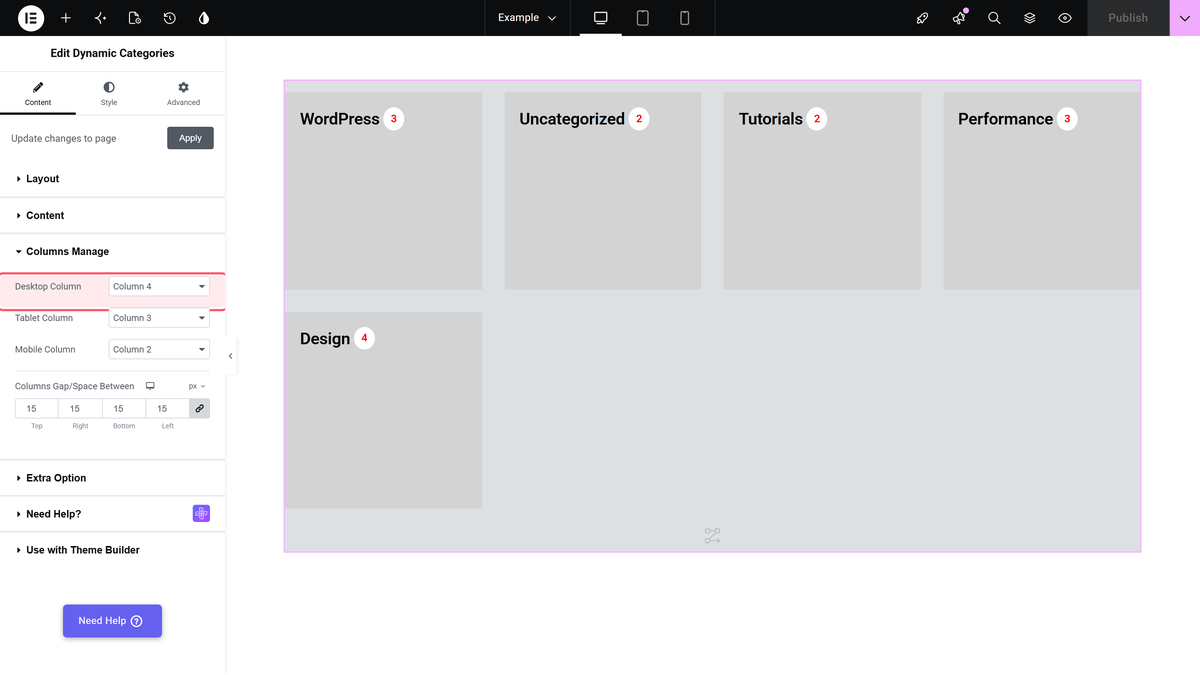
Under **Columns Manage**, set independent column counts for **Desktop** (default 3), **Tablet** (default 4) and **Mobile** (default 6), plus a **Columns Gap** for the space between grid items.

![Desktop/Tablet/Mobile column count controls](https://theplusaddons.com/wp-content/uploads/2026/09/dynamic-categories-grid-columns.webp)

## Settings Overview

| Setting | What it does | Default |
| ------- | ------------ | ------- |
| Layout | Grid arrangement (this doc's focus). | Grid |
| Desktop Column | Columns shown on desktop. | 3 |
| Tablet Column | Columns shown on tablet. | 4 |
| Mobile Column | Columns shown on mobile. | 6 |

## Related Docs

- [How to Add Categories Listing in Elementor?](https://theplusaddons.com/docs/add-categories-listing-in-elementor/)- [How to Create Category Masonry Grid in Elementor?](https://theplusaddons.com/docs/create-category-masonry-grid-in-elementor/)- [How to Create Category Metro Layout in Elementor?](https://theplusaddons.com/docs/create-category-metro-layout-in-elementor/)

## Frequently Asked Questions

**Q: What do I need before creating a category grid in Elementor?**
A: Elementor free needs to be installed and active first, because the tutorial is built around the Dynamic Categories widget inside Elementor. The Plus Addons for Elementor, The Plus Addons, Plus Addons for Elementor, POSIMYTH provides the widget as a free feature, so no Pro licence is required. A practical gotcha is that the widget still has to be enabled under The Plus Addons &gt; Widgets before it appears in the editor.

**Q: Why is the category grid layout useful for listing categories?**
A: The Grid layout works well because it shows categories in even rows and columns, which makes terms easier to scan quickly. In The Plus Addons for Elementor, The Plus Addons, Plus Addons for Elementor, POSIMYTH, this is also the default layout for the Dynamic Categories widget. That default matters when you want a clean starting point without switching layouts or rebuilding the structure from scratch.

**Q: How do I show a taxonomy other than the default Category?**
A: The Dynamic Categories widget lets you choose which taxonomies to list instead of being locked to the default Category. That makes it useful when your site organizes content with a different taxonomy and you still want a grid presentation. The practical detail is that the Grid layout stays responsive while you change the taxonomy source, so the display structure remains consistent.

**Q: What column counts does the category grid use on desktop, tablet, and mobile?**
A: The default column counts are 3 on Desktop, 4 on Tablet, and 6 on Mobile. Those values are set under Columns Manage in the Dynamic Categories widget from The Plus Addons for Elementor, The Plus Addons, Plus Addons for Elementor, POSIMYTH. A useful detail is that these are independent controls, so you can tune each breakpoint separately instead of forcing one layout across all devices.

**Q: How do I control spacing between category items in the grid?**
A: Columns Gap controls the space between grid items in the Dynamic Categories widget. That setting matters because tight spacing can make category cards feel crowded, while too much gap can waste space and weaken scanability. In this tutorial’s Grid layout setup, spacing is handled alongside column counts under Columns Manage, so both density and readability stay under control.

**Q: Is there another way to display categories besides a grid?**
A: The related docs point to two other layouts: Category Masonry Grid and Category Metro Layout. That gives you alternatives when a standard even-column grid is too rigid for your design. For a straight listing workflow there is also [How to Add Categories Listing in Elementor?](https://theplusaddons.com/docs/add-categories-listing-in-elementor/), while the live widget is here: [LIVE WIDGET LINK](https://theplusaddons.com/elementor-listing/dynamic-category/?utm_source=tpae&amp;utm_medium=docs&amp;utm_campaign=text).