




---
title: "How to Create a WooCommerce Product Archive Page in Elementor?"
url: https://theplusaddons.com/docs/create-a-woocommerce-product-archive-page-in-elementor/
date: 2023-08-08
modified: 2026-09-11
lang: en
author: "Aditya Sharma"
description: "Do you want your shop and product category pages to match the rest of your design? One archive template can cover all of them. The Woo Product Listing widget in..."
image: https://theplusaddons.com/wp-content/uploads/2023/08/How-to-Create-a-WooCommerce-Product-Archive-Page-in-Elementor_-1024x536.jpg
word_count: 376
---

# How to Create a WooCommerce Product Archive Page in Elementor?

## 

- The Woo Product Listing widget in The Plus Addons for Elementor reads the category or tag the shopper opens and lists its products on a single archive template.
- The widget is part of The Plus Addons for Elementor Pro, and it does not appear in the widget panel of the free plugin.
- The archive setup uses Product Listing Types set to Archive Page, with style options like Grid, Masonry, Metro or Carousel, plus pagination or a Load More button in Content > More Post Options.

Do you want your shop and product category pages to match the rest of your design? One archive template can cover all of them.

The Woo Product Listing widget in The Plus Addons for Elementor reads whichever category or tag the shopper opened and lists its products.

*To check the complete feature overview documentation of The Plus Addons for Elementor Product Listing widget, [click here](https://theplusaddons.com/docs/product-listing-widget-settings-overview/).*

***Requirement - This widget is a part of The Plus Addons for Elementor, make sure it's installed & activated to enjoy all its powers.***

[LIVE WIDGET LINK](https://theplusaddons.com/elementor-listing/?utm_source=tpae&utm_medium=docs&utm_campaign=text#woo-products-wgts)

## Before You Start

- **Edition:** **Pro** — the Woo Product Listing widget is part of The Plus Addons for Elementor Pro. It does not appear in the widget panel of the free plugin.- **WooCommerce** installed and active, with some published products.- **A product archive template** from [Nexter Builder](https://nexterwp.com) or Elementor Pro's Theme Builder, set to display on product archives.- **Widget to enable:** Woo Product Listing, switched on under **ThePlus Settings > Widgets**.

## Step 1: Add the widget to the archive template

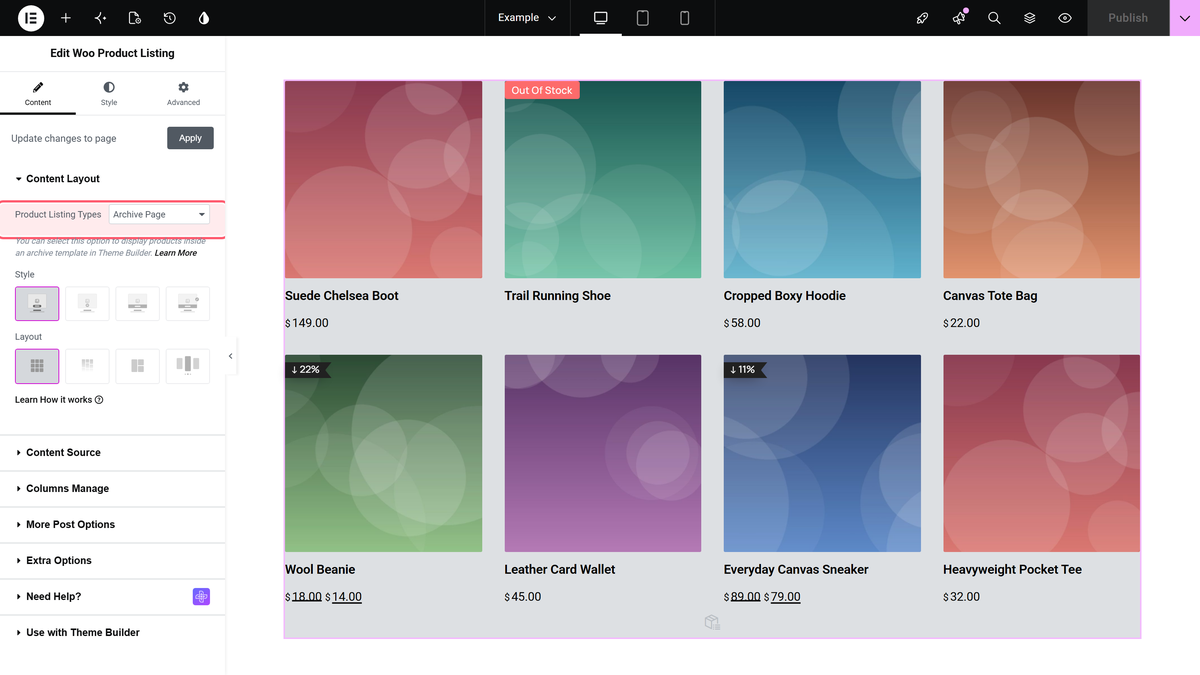
Edit the product archive template and drag in the **Woo Product Listing** widget. In **Content > Content Layout**, set **Product Listing Types** to **Archive Page**.

![Product Listing Types set to Archive Page](https://theplusaddons.com/wp-content/uploads/2026/09/tp-product-listout-product-listing-types-wide-archive.webp)

## Step 2: Style and layout

Choose a **Style** and a **Layout** — Grid, Masonry, Metro or Carousel. Grid suits most shops.

## Step 3: Paging

In **Content > More Post Options**, add [pagination](https://theplusaddons.com/docs/add-pagination-to-woocommerce-products-in-elementor/) or a [Load More button](https://theplusaddons.com/docs/add-load-more-button-in-woocommerce-products-in-elementor/).

With no loading option set, **Hide Out of Stock Product** in **Content > Extra Options** keeps sold-out items off the archive.

## Step 4: Publish and check

Publish the template and open a product category on the front end. Each category shows its own products.

## Limitations

- **Pro only.** The Woo Product Listing widget is not in the free plugin.- **Query controls are hidden.** Category, include and exclude fields disappear, because the archive decides the products.- **No Category Wise Filter** on Archive Page listings.

## Troubleshooting

### Every category shows all products

Product Listing Types is still Normal Page. Set it to Archive Page.

### The shop still shows the theme's layout

Check the template's display condition covers the shop and product archives.

## Related Docs

- [Woo Product Listing widget: settings overview](https://theplusaddons.com/docs/product-listing-widget-settings-overview/) — every control in the widget.- [Style the product search results page](https://theplusaddons.com/docs/customize-woocommerce-search-results-page-in-elementor/)- [Show related products on the product page](https://theplusaddons.com/docs/show-related-products-on-a-product-page/)- [Add a quick view button](https://theplusaddons.com/docs/add-quick-view-button-on-woocommerce-products-in-elementor/)

## Frequently Asked Questions

**Q: What do I need before creating a WooCommerce product archive page in Elementor?**
A: The setup depends on four things: WooCommerce must be installed and active, you need some published products, you need a product archive template from Nexter Builder or Elementor Pro’s Theme Builder, and the Woo Product Listing widget must be enabled under ThePlus Settings &gt; Widgets. The Plus Addons for Elementor, The Plus Addons, Plus Addons for Elementor, POSIMYTH provides the Woo Product Listing widget as part of the Pro version, so it will not appear in the free plugin.

**Q: Why does every category show all products instead of only its own products?**
A: That usually means Product Listing Types is still set to Normal Page. For archive templates, the widget has to read the category or tag that the shopper opened, so Archive Page is the setting that makes each archive pull its own product set. This is a common gotcha when the template is built correctly but the listing mode is still treating it like a regular page.

**Q: What layout should I use for a WooCommerce product archive page?**
A: The widget supports Grid, Masonry, Metro, and Carousel layouts. Grid is the safest default for most shops because it keeps category archives predictable and easy to scan. Masonry and Metro are better when you want a more visual catalog feel, while Carousel changes the archive into a sliding presentation instead of a standard product grid.

**Q: How do I add pagination or a Load More button to product archives?**
A: Paging is handled in Content &gt; More Post Options, where you can add pagination or a Load More button. That choice matters because it controls how shoppers move through larger catalogs without forcing everything onto one long page. If you leave loading options off, sold-out items can still be hidden with Hide Out of Stock Product in Content &gt; Extra Options.

**Q: Why is my shop still showing the theme's layout after publishing the archive template?**
A: That usually comes down to display conditions. The template has to cover both the shop and product archives, otherwise the theme’s own layout can keep winning on the front end. Publishing alone is not enough here. The important part is making sure the archive template’s display condition actually targets the shop and product archive pages.

**Q: Can I use this for both shop pages and category pages in one template?**
A: One archive template can cover all of them if it is built as a product archive template and set up to display on product archives. The Woo Product Listing widget reads whichever category or tag the shopper opened and lists its products, so the same structure can serve shop and category views without rebuilding each page separately. That is why this approach fits stores that want consistent design across archives.