






A custom post type usually holds more than one group of things — books by author, properties by city, recipes by course. Most of the time you want a listing for one group, not the whole lot.
Taxonomies and Taxonomies Slug in the Dynamic Smart Showcase widget from The Plus Addons for Elementor narrow the listing to the terms you name.
To check the complete feature overview documentation of The Plus Addons for Elementor Dynamic Smart Showcase widget, click here.
Requirement – This widget is a part of The Plus Addons for Elementor Pro, make sure it’s installed & activated to enjoy all its powers.
Before You Start
- Edition: Pro — Dynamic Smart Showcase is only in The Plus Addons for Elementor Pro. With the Pro plugin switched off the widget is not in the editor at all, and a page that already uses it shows nothing where the widget was.
- Widget to enable: Dynamic Smart Showcase, switched on under The Plus Addons > Widgets.
- You need a custom post type: registered as public with show_ui on, or it will not appear in the Post Type dropdown.
- You need a custom taxonomy: registered as public, attached to that post type, with terms assigned to the entries you want to show.
- Raise the post count: Maximum Posts Display in Content Source defaults to 1, so a freshly dropped widget shows a single post. Set it to the number you want, or to -1 for every matching post.
How to Find the Term Slug
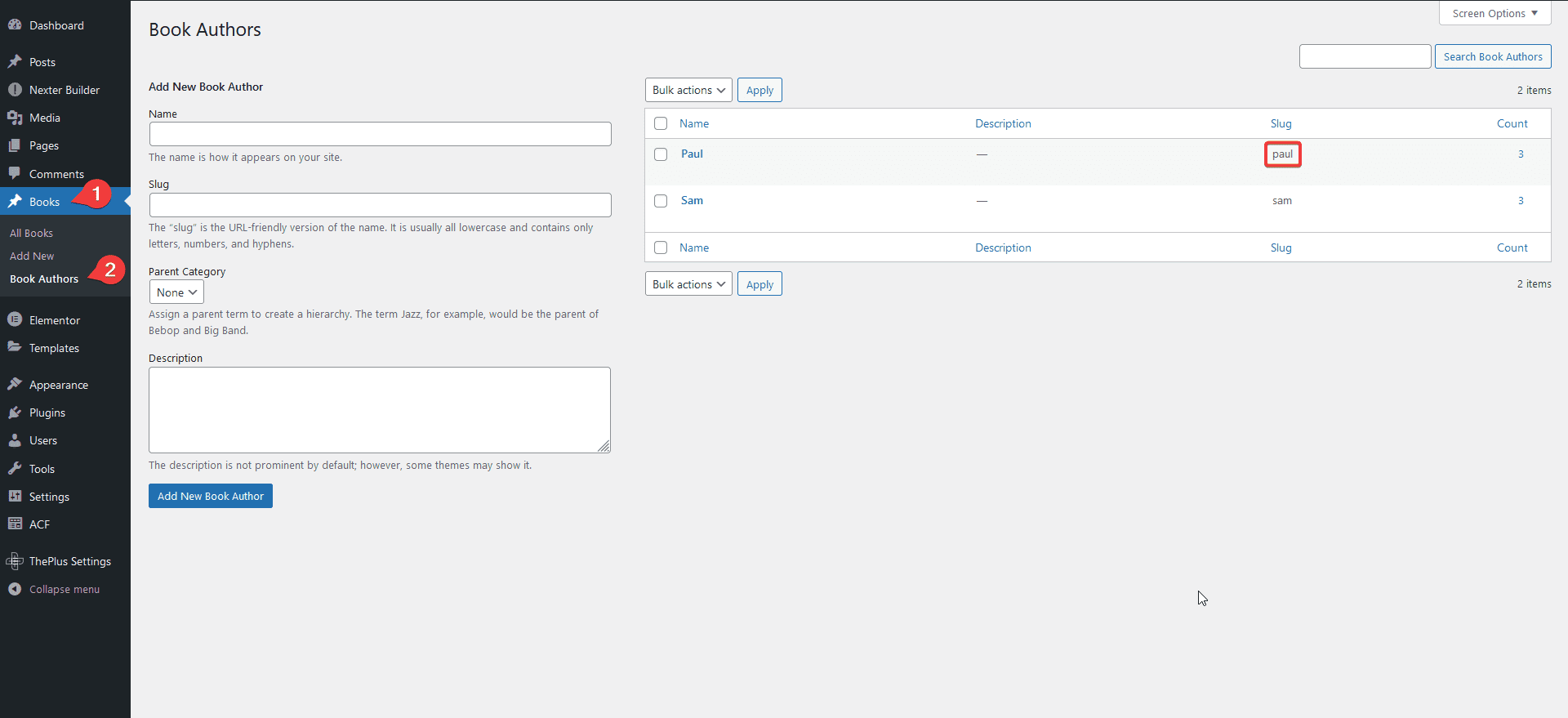
- In the WordPress dashboard, open your custom post type and then its taxonomy screen. In the example below that is Books > Book Authors.
- Find the term you want in the list.
- Copy the value in the Slug column — not the name. “Paul Adler” is usually stored as
paul-adler.
How to Use It
- Select the Dynamic Smart Showcase widget on your page.
- In Layout, set Post Type to your custom post type.
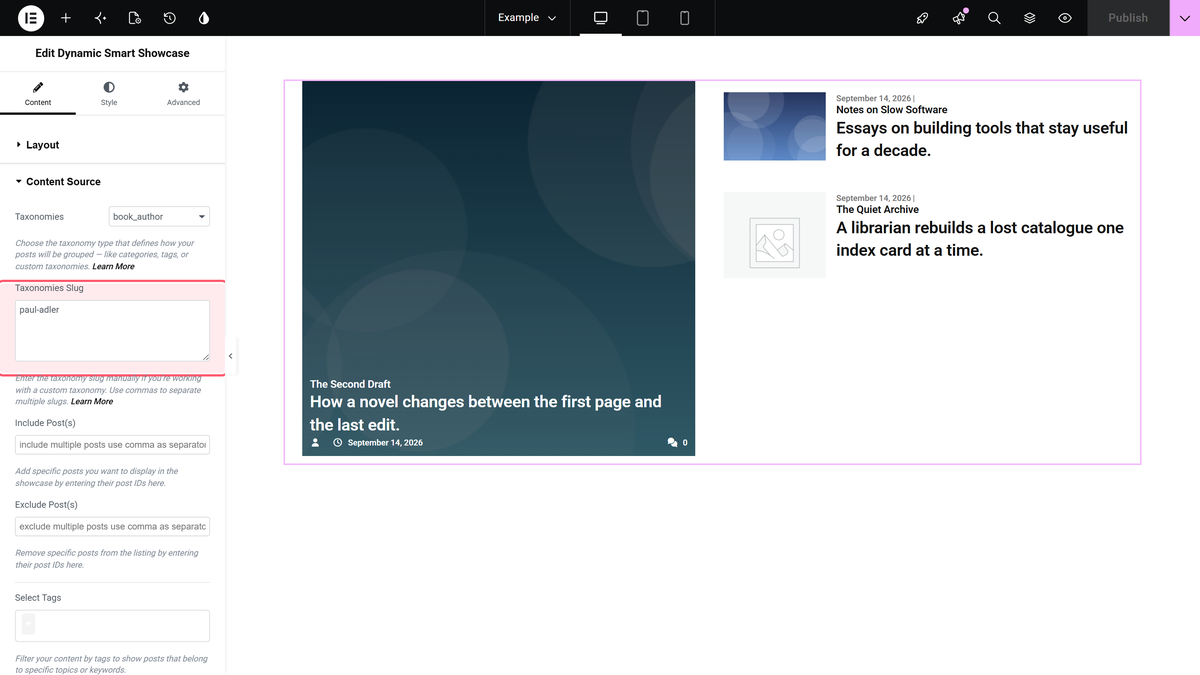
- Open Content Source. Select Category is replaced by Taxonomies as soon as the post type is not Posts.
- Pick your taxonomy in Taxonomies. The dropdown lists registered taxonomy names, so “Book Authors” appears as
book_author. - Type the term slug into Taxonomies Slug. For several terms, separate them with commas.
The Result
Only the entries in that term are listed:

How It Behaves
- Several slugs are combined with OR:
paul-adler,lena-fischerreturns the entries of either term. - A space after the comma is tolerated —
paul-adler, lena-fischerreturns the same entries. - Leaving Taxonomies Slug empty lists the whole post type.
- Include Post(s), Exclude Post(s), Offset Posts, Order By and Order still apply on top of the taxonomy filter.
- If no entry carries the slug you typed, the widget prints Posts not found.
Limitations
- The field takes slugs, not term names or IDs. A name with a capital letter or a space will not match.
- Taxonomies and Taxonomies Slug are hidden while Post Type is Posts. Use Select Category and Select Tags for blog posts.
- Only one taxonomy can be used at a time. You cannot combine two different taxonomies in the same listing.
- The dropdown shows the registered taxonomy name rather than its display label, so you need to recognise your taxonomy by its slug.
Troubleshooting
The listing is empty
Check the slug against the Slug column on the taxonomy screen, and make sure the taxonomy selected in Taxonomies is the one those terms belong to.
I only see Select Attributes in the dropdown
That is the placeholder entry. If nothing else is listed, the post type has no public taxonomy attached to it.
There is no Taxonomies field
Post Type is still set to Posts. Change it to your custom post type and the field appears.
