





The Thank You page is the final page a customer sees after completing a purchase, and it reinforces a positive shopping experience. The default WooCommerce Thank You page may not match your brand or display all the information your customers need.
The Woo Thank You widget in The Plus Addons for Elementor lets you customize the WooCommerce Thank You page in the Elementor editor. You can control the order confirmation message, order meta details, the items list, billing and shipping addresses, and every label on the page.
To check the complete feature overview documentation of The Plus Addons for Elementor Woo Builder, click here.
Best Used For:
- WooCommerce stores that want a branded post-purchase confirmation page instead of the plain WooCommerce default
- Online shops that display upsell offers or discount codes after checkout
- Agencies building custom WooCommerce storefronts for clients in Elementor
Required Setup
- Elementor FREE Plugin installed & activated.
- You need to have The Plus Addons for Elementor plugin installed and activated.
- This is a Premium widget, and you need the PRO version of The Plus Addons for Elementor.
- Make sure the Woo Thank You widget is activated, to verify this visit The Plus Addons → Widgets → and Search for Woo Thank You and activate.
How to Activate the Woo Thank You Widget?
Go to
- The Plus Addons → Widgets
- Search the widget name and turn on the toggle.

Assign Thank You Page
By default, WooCommerce does not have a separate Thank You page, so you need to create a page first.
From the Dashboard, go to The Plus Addons > Extra Options > Settings, scroll down to the WooCommerce Thank You Page section, click the settings icon, select your page from the dropdown, and click Save.

Add Woo Thank You
Edit your Thank You page with Elementor and add the Woo Thank You widget.
If you want to build a complete post-purchase flow, you can also customize the checkout step using the How to Edit WooCommerce Checkout Page in Elementor doc.
Woo Thank You
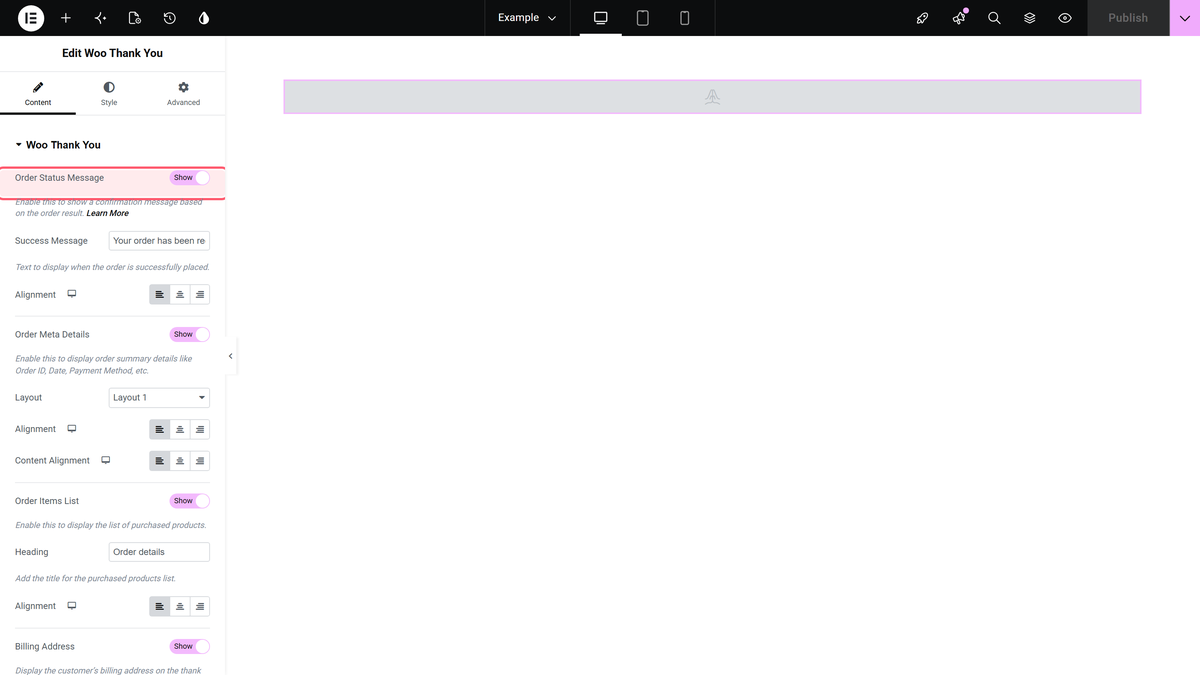
Enable the Order Status Message toggle to show the order confirmation message and the order meta details block on the page. Disable it when you want to show only the items list and addresses without the confirmation header. Use this when building a minimal Thank You page that leads customers directly to order details.

When the Order Status Message toggle is on, the Success Message field and an Alignment section become available. In the Success Message field, enter the confirmation message you want customers to see after a successful order. From the Alignment section, set the horizontal alignment of this message.
After enabling Order Status Message, the Order Meta Details toggle becomes available. Enable it to show the order number, date, email, total, and payment method in a row. Disable it when you want a clean confirmation page without the repeated order summary. Use this when your Thank You page redirects customers to a separate order email for full details.
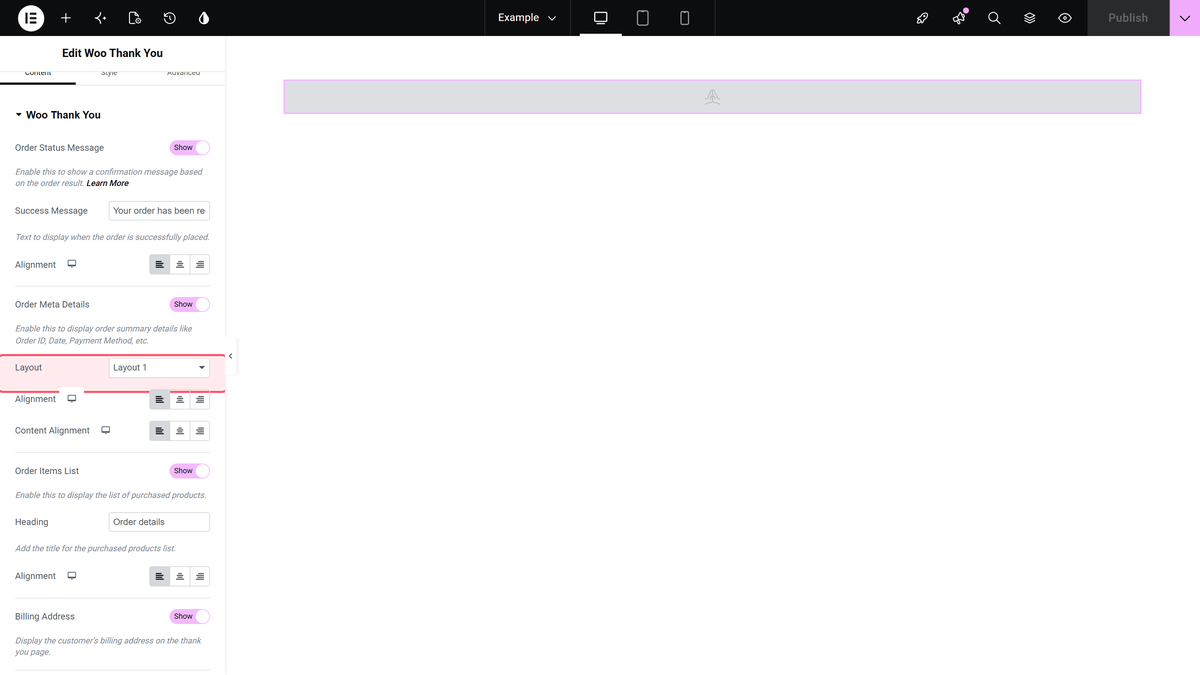
From the Layout dropdown, choose the layout for the meta details section. Use this when your Thank You page has a narrow column and you need the meta details to stack vertically instead of appearing in a row.
From the Alignment section below the layout, align the meta details row on the page.
From the Content Alignment section, set the alignment of the full widget container.
Enable the Order Items List toggle to display the purchased items in a table. Use this when customers need to verify what they ordered without leaving the Thank You page or checking their email.
In the Heading field, edit the heading text that appears above the order items table.
From the Alignment section under the Heading field, align the heading of the items list.
Enable the Billing Address toggle to display the billing address section on the Thank You page. Use this for stores that sell physical products and want customers to confirm their billing details at the point of purchase.
Enable the Shipping Address toggle to display the shipping address section. Use this when your store ships physical products and you want customers to verify the delivery destination immediately after checkout.
To add urgency to related WooCommerce pages, see How to Add a Scarcity Countdown Timer in WooCommerce Checkout, Cart & Product Pages.
Label
From the Label tab, edit the text for every label and section heading that appears on the Thank You page. This is useful when your store uses a different language or when your brand requires custom terminology instead of the WooCommerce defaults.

Suggested reading, 5 best WooCommerce product search plugins
Order Fail – To set the message displayed when an order fails. Use this when you want a clear error message that matches your brand voice instead of the default WooCommerce failure text.
Pay – To edit the text of the Pay button that appears when an order has failed. Use this when your payment flow uses custom terminology and “Pay” does not match your button style.
My account – To edit the My Account button text displayed when an order has failed.
Order Number – To edit the order number label for successful orders. Use this when your store uses a custom reference term such as “Booking ID” or “Reference Number” instead of “Order Number”.
Date – To edit the date label for successful orders.
Email – To edit the email label for successful orders.
Total – To edit the total label for a successful order. Use this when your store serves B2B customers and needs a label like “Invoice Total” instead.
Payment method – To edit the payment method label for successful orders.
Product – To edit the product column label in the order details section.
Total – To edit the total column label in the order details section.
Note – To edit the note label in the order details section.
Billing address – To edit the billing address section heading.
N/A – To edit the N/A placeholder shown when no billing address is on file.
Shipping address – To edit the shipping address section heading.
N/A – To edit the N/A placeholder shown when no shipping address is on file.
From the Style tab, customize the typography, colors, and spacing for each section of the Thank You page.
Your custom Thank You page is now live.

Also, read how to create a WooCommerce order tracking page in Elementor.