



Ask Grok a question on X or in the app and it answers in seconds, often with a short list of sources underneath.
If your site is not in that list, you are invisible to a fast-growing slice of how people now search. Getting into Grok’s answers is worth doing, but Grok does not work like ChatGPT or Perplexity, and the usual AI-SEO checklist only gets you part of the way.
Here is what actually moves the needle, and what to stop worrying about.
How Grok finds and cites content
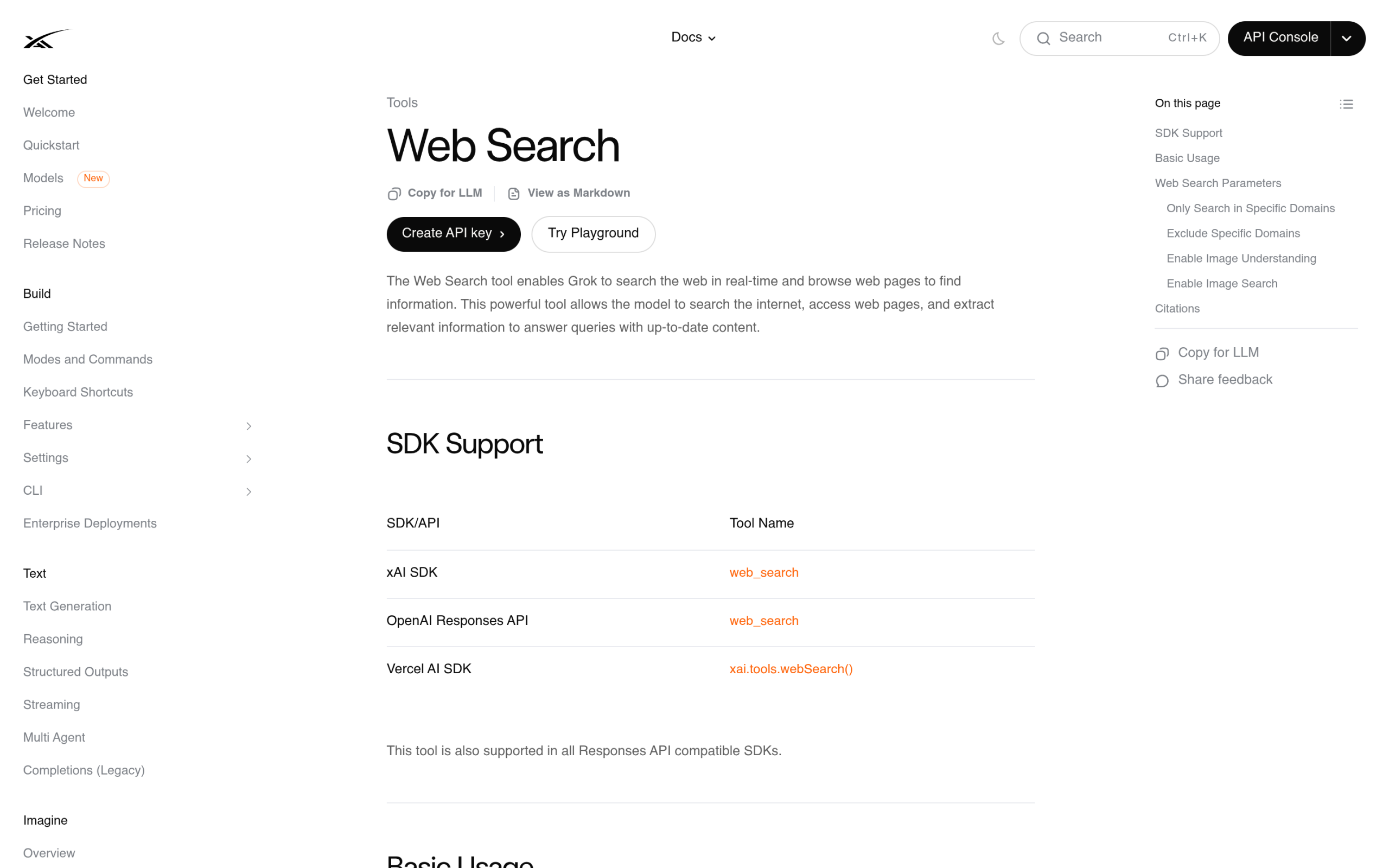
Grok’s DeepSearch and Web Search tools run parallel searches across the live web and across X, follow fresh links, and return an answer with inline numbered citations drawn from both web pages and X posts.
xAI’s own developer documentation describes the underlying web search and X search tools, and independent reviews of Grok describe a sources panel that separates the two.
Two things follow from it.
First, X is a first-class source for Grok, not an afterthought, which is the single biggest way it differs from other engines.
Second, freshness matters, because Grok is pulling live results at the moment of the question rather than leaning only on a slow training snapshot.
The honest catch: Grok’s citations are unreliable
Before you optimize for Grok citations, know what they are worth today.
In Columbia Journalism Review’s Tow Center study of eight AI search tools, Grok was the worst performer, returning incorrect or fabricated source citations on about 94 percent of test queries.
For comparison, the best performer in that study, Perplexity, was still wrong 37 percent of the time. The practical takeaway is not to give up, it is to set expectations honestly.
You cannot control what Grok attributes, and even a well-sourced answer can miscredit you. So the goal is not to game a citation, it is to make your site the clearest and most obviously authoritative source on your topic, so that when Grok does pull and attribute correctly, it pulls you.
Why robots.txt will not reliably gate Grok
For most AI engines you manage access in robots.txt by allowing or blocking named crawlers like GPTBot, ClaudeBot, PerplexityBot, and Google-Extended. Grok is the exception.
Crawler-tracking services list xAI user-agent tokens such as GrokBot, xAI-Grok, and Grok-DeepSearch, but site operators report almost never seeing them in their logs.
Grok has instead been observed fetching pages as ordinary browser traffic and effectively ignoring robots.txt, so a rule written to target Grok often matches nothing.
If your goal is to keep Grok out rather than court it, the only dependable route is server level: a web application firewall such as Cloudflare’s AI crawl controls, IP rules, or rate limiting.
For getting cited, the takeaway is simpler. You cannot opt into Grok through robots.txt, so being publicly crawlable and genuinely present on the open web and on X is what counts.
What actually improves your odds of being cited by Grok
Because Grok blends live web results with X, the winning approach is part content quality and part presence. These are the levers that matter most:
- Be present and discussed on X. Grok weights X heavily, so an active profile, posts that earn shares, and your content being linked in real conversations all raise your visibility inside Grok in a way that simply does not apply to other engines.
- Answer the question directly and early. Clear, factual, self-contained passages are far easier for a retrieval agent to lift and attribute than a point buried ten paragraphs down.
- Add structured data. Article, FAQ, and HowTo schema, plus Speakable markup, give machines an unambiguous read of what your page actually says.
- Keep it fresh. Because Grok pulls live, recently updated and clearly dated content has an edge on anything timely.
- Establish authorship and expertise. A real, credentialed author signals a trustworthy source, the same experience and authority signals that help you across all of search.
- Make your content machine-readable. An llms.txt file and clean Markdown versions of your posts give AI tools a friction-free path to your actual words instead of a page wrapped in scripts.
None of this is a trick. It is the same foundation that helps you show up across AI search engine optimization on WordPress generally, applied with an extra emphasis on X and freshness for Grok specifically.
How to tell if it is working
Do not expect a clean “Grok sent you 200 visits” line in your analytics. Because Grok rarely identifies itself and its citations are shaky, the honest way to measure is by direction, not by a precise number.
Watch your overall AI-referral traffic trend, check by hand whether your pages come up when you ask Grok questions in your niche, and keep an eye on engagement for the X posts that link your content.
Treat it as a trend you nudge upward over months, not a scoreboard you refresh daily.
Where RankReady fits
Since Grok rewards clearly structured, machine-readable, authoritative content, the practical work is making your WordPress site exactly that, and doing it by hand across every post is tedious.
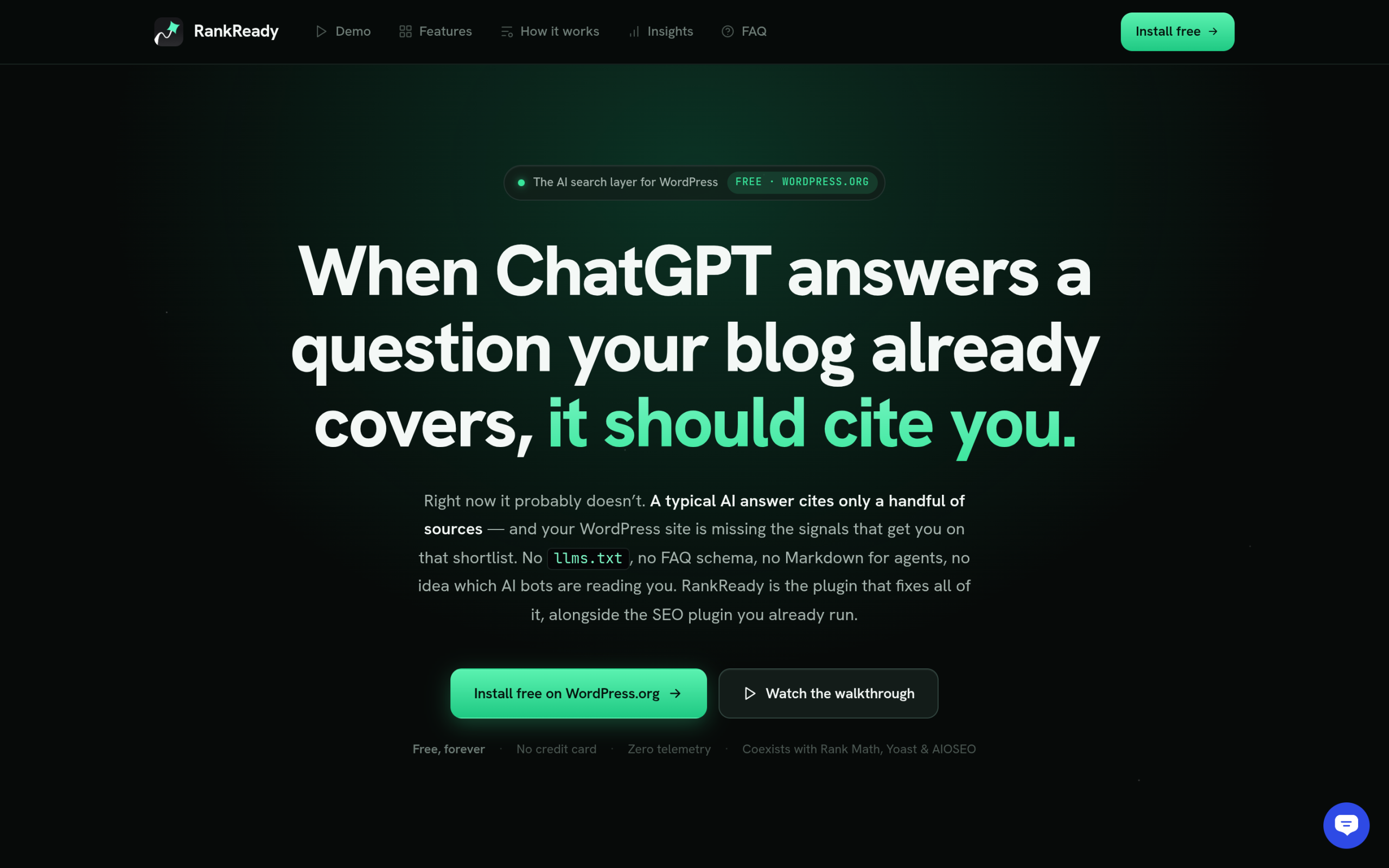
This is the layer RankReady handles. It adds Article, FAQ, HowTo, and Speakable schema, generates an llms.txt and llms-full.txt plus clean Markdown endpoints of your posts, and adds an author box with Person schema for your expertise signals, so both search engines and AI tools get an unambiguous read of your content.
For the AI engines that do respect robots.txt, it manages 31 crawlers, including GPTBot, ClaudeBot, PerplexityBot, Google-Extended, and Bytespider, from a single screen, and it tracks AI citations and referrals from engines like ChatGPT, Perplexity, Claude, and Google so you can watch your AI visibility trend over time.
It will not hand you a dial that controls Grok, because nothing does, but it makes your site the kind of clear, citable source that Grok and every other engine are most likely to pull from.
Suggested reading
- LLM optimization for WordPress, how to get your content into AI answers overall.
- AI search engine optimization on WordPress, the full 2026 playbook.
- Generative Engine Optimization for WordPress, the honest AEO and GEO guide.
- OAI-SearchBot on WordPress, the crawler that puts you in ChatGPT Search.
- Robots.txt generator for WordPress, control AI crawlers without editing code.