
Meta’s 17 standard events cover shops and lead forms, but not everything. An affiliate signup, a brochure download or a pricing-page click has no standard name.
The Event Tracker extension of The Plus Addons for Elementor lets you send a custom Meta Pixel event with a name you choose, from any Elementor widget.
To check the complete feature overview documentation of The Plus Addons for Elementor Event Tracker extension, click here.
Requirement – This extension is a part of The Plus Addons for Elementor Pro, make sure it’s installed & activated to enjoy all its powers.
Before You Start
- Edition: Pro — Event Tracker ships only in The Plus Addons for Elementor Pro. With the free plugin alone the Events Tracker section does not appear in the Advanced tab at all.
- Extension to enable: Event Tracker, under The Plus Addons > Extensions in the Plus Visibility group. It is off until you turn it on.
- Prerequisite: a Meta (Facebook) Pixel ID on the site, either saved under The Plus Addons > Settings > Analytics > Facebook Pixel ID or already added by another plugin or a tracking script.
- Prerequisite: something to click. The event fires on a click, so put the tracker on a button, a link, a form submit button or a video play button — not on a block of plain text.
Send a Custom Meta Event
- Select the widget in Elementor and open the Advanced tab.
- Scroll to the bottom and open Events Tracker.
- Turn on Facebook Pixel.
- Set Event Type to Custom.
- A new Event Value field appears. Type your event name there, for example
AffiliateSignup. The placeholder suggests i.e Affiliate. - Update the page.
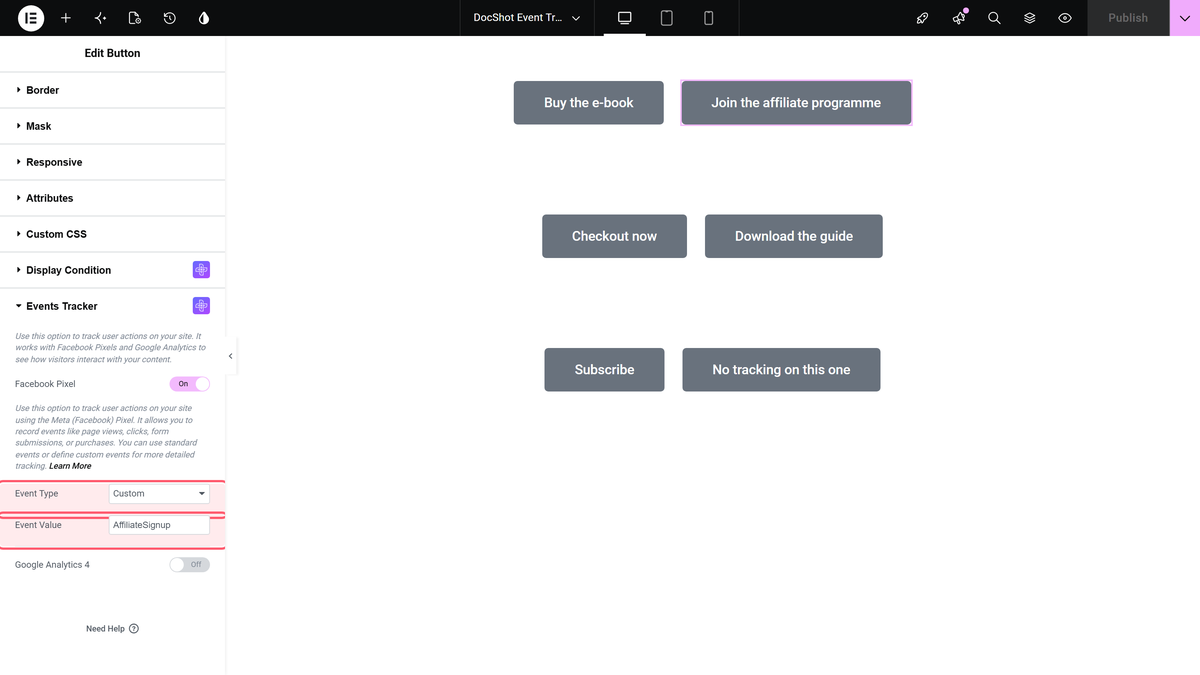
The Event Value field holds the name of your event, not a monetary value. Keep it short, without spaces, and use the same spelling everywhere — Meta treats a different spelling as a different event.
Check That the Event Fires
On the published page a click sends the custom name straight to Meta. This is what the browser actually sent on a test page:
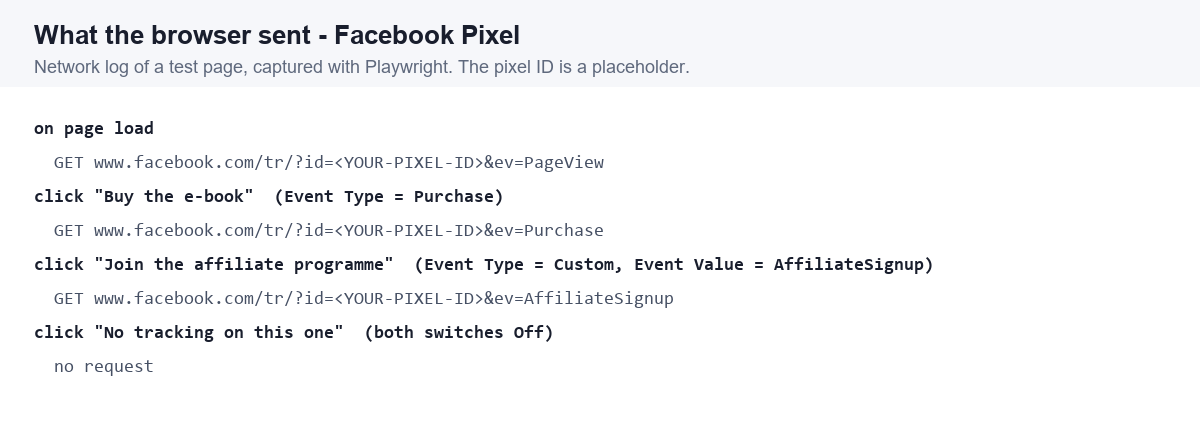
To check it on your own site, install the Meta Pixel Helper Chrome extension.
- Open the page in Chrome and click the Meta Pixel Helper icon. You will see the default PageView event.
- Click your button, then open Meta Pixel Helper again. Your custom event now sits alongside PageView.
- After a few minutes the custom event also appears in Events Manager on Meta’s site, under Custom conversions or in the event list for your pixel.

How It Behaves
- A custom event is sent as
trackCustom, a standard one astrack. Meta lists the two kinds separately. - The name is sent exactly as typed, including capitals.
- As with standard events, the click on any link inside the element is what triggers it.
- Fill Event Value in. With Event Type set to Custom and the field left empty, no event name is passed to the pixel at all.
Limitations
- No parameters are sent. The Event Properties repeater belongs to the Google Analytics 4 switch, not to the Meta one, so a custom Meta event carries its name and nothing else.
- One custom event per element. You cannot send both a standard and a custom Meta event from the same widget.
- Custom events are not validated. A typo simply creates a second, near-identical event in Events Manager.
Troubleshooting
Meta Pixel Helper shows PageView but not my custom event
Check that Event Type is Custom and that Event Value is not empty, then update the page and reload it in the browser.
Nothing useful arrives for the custom event
Check the Event Value field is filled in. With Event Type set to Custom and the field empty, the extension has no name to send.
I see two versions of the same event in Events Manager
The name was spelled differently on two elements. Meta matches on the exact string, so AffiliateSignup and Affiliate Signup are two events.