
An Elementor template lets you design a message box’s contents visually – a text block, an image, a button – and reuse that design as the Message Box widget’s description.
It is a Free widget of The Plus Addons for Elementor.
Requirement – This widget is a part of The Plus Addons for Elementor, make sure it’s installed & activated to enjoy all its powers.
Before You Start
- Edition: Free.
- You need a way to turn a saved Elementor template into a shortcode: Elementor Pro’s own template shortcode, or the free Anywhere Elementor plugin if you don’t have Elementor Pro.
How to Add a Template as a Message Box Description
| Step | What to do |
|---|---|
| 1 | Go to Templates > Saved Templates, click Add New Template (or import one), design the content you want inside the message box, and save it. |
| 2 | Get that template’s shortcode – from Elementor Pro if you have it, or from the Anywhere Elementor plugin if you don’t. |
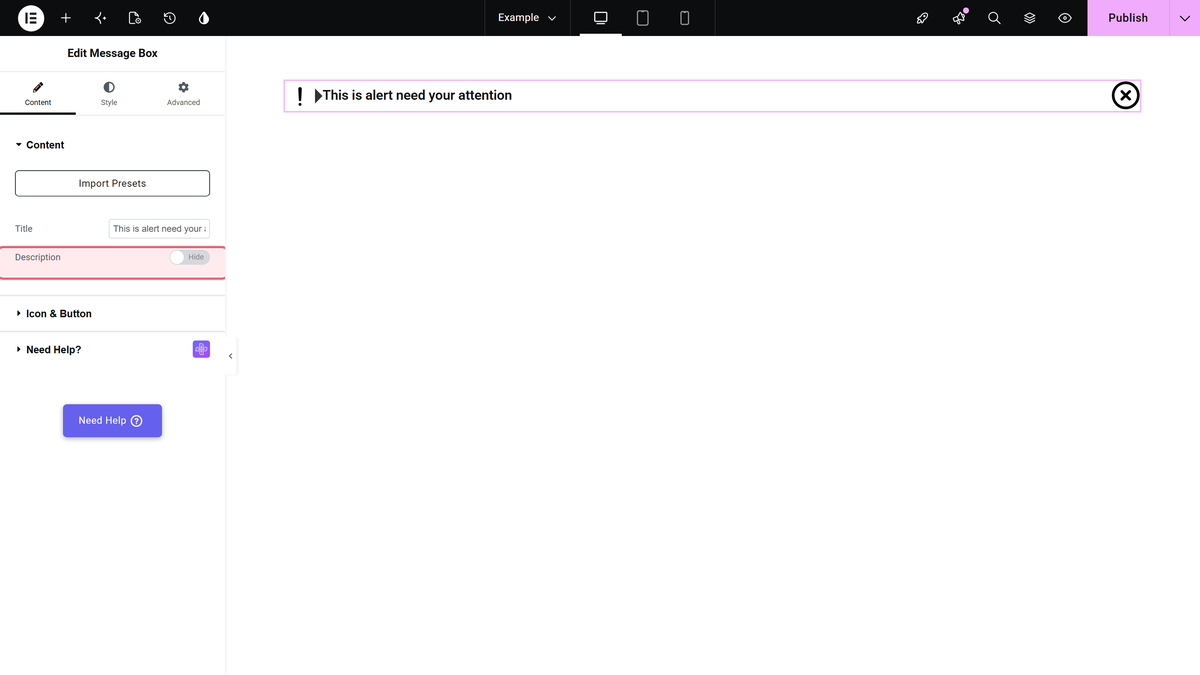
| 3 | Add a Message Box widget to a page, turn on the Description toggle, and paste the shortcode into the description field. |
How It Behaves
We confirmed directly that the Description field is a genuine rich-text (WYSIWYG) field: pasted HTML – including bold text and other formatting – renders exactly as written on the published page, not stripped down to plain text.
Limitations
- This method needs Elementor Pro or the Anywhere Elementor plugin just to generate the template’s shortcode – the Message Box widget itself has no built-in template picker like some other widgets in The Plus Addons do.
The shortcode shows as plain text instead of the template’s design
Check that the plugin providing the shortcode (Elementor Pro or Anywhere Elementor) is active and that the template is published, not a draft.
Not verified
So you know exactly what has and has not been checked:
- The full shortcode chain end to end – pasting a real Elementor Pro or Anywhere Elementor shortcode into the Description field and seeing the template’s design appear. Neither plugin is installed in our test environment. We confirmed the field itself is a working rich-text field that renders HTML correctly, which is what the shortcode ultimately outputs into.