I have built FAQ sections for client sites on most of the plugins in this list, so this is not a feature-sheet roundup copied from seven landing pages. The goal here is simpler: by the end you should know which one to install for your exact setup, and why. I will also be upfront about two things most lists skip: what Google changed in 2026, and the fact that the plugin every big roundup puts at number one does not actually build a visible FAQ at all.
Short answer: if you build with Elementor, install Advanced Accordion by The Plus Addons for Elementor for the most design control. On Gutenberg, reach for Easy Accordion when you want something lightweight, or Ultimate Blocks if you also want a wider block suite. Pick Helpie FAQ for a searchable knowledge base, Ultimate FAQ for a large categorized library, and Accordion FAQ when budget styling matters most. All in One SEO belongs in the conversation too, but for the schema rather than the display, which I explain below. Every option here has a free version; live install counts, pricing, and the 2026 schema change are below.
What a WordPress FAQ Plugin Actually Does
A WordPress FAQ plugin lets you build, place, and style question-and-answer sections, usually as collapsible accordions, without touching code. That is the whole job. The good ones add structure on top of it: categories, search, schema markup, reusable templates, and styling controls so the section matches your brand instead of looking bolted on.
There is a split worth understanding before you pick one, because it explains why different roundups recommend completely different tools. Some plugins handle the display, the accordion your visitor clicks. Others handle the schema, the machine-readable Q&A that search engines and AI systems parse. A few do both. Getting this wrong is the most common reason people install an FAQ plugin and then wonder why nothing looks different on the page, or why their FAQ looks fine but no engine can read it.
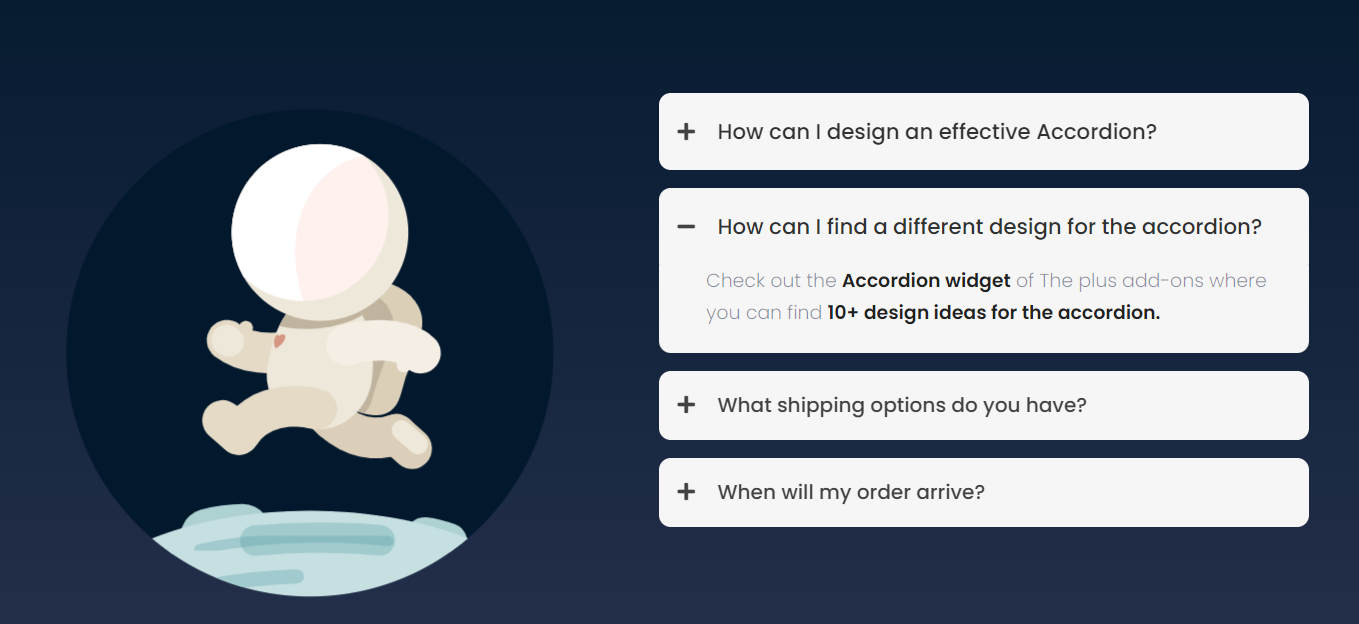
You can build FAQs by hand, but on a real site it gets tedious fast: every new question means more markup to format, and keeping the styling consistent across pages is a chore. A plugin turns that into a repeatable block you can drop anywhere. Here is an example built with the Advanced Accordion widget from The Plus Addons for Elementor.
Why a Dedicated FAQ Section Still Earns Its Place
A well-built FAQ does three jobs at once. It answers the objections that sit between a visitor and a purchase, so fewer people bounce to email you the same question. It cuts repetitive load off your support team. And it gives search engines and AI answer engines a clean, structured block of question-and-answer content they can lift from. That last point is where 2026 changed the math, so let’s deal with it directly before the list.
Do FAQ Plugins Still Help SEO in 2026?
Yes, but not the way the old guides promised. On May 7, 2026, Google stopped showing FAQ rich results, the expandable question boxes that used to appear under a search listing, for almost every site. The FAQ search appearance and the Rich Results Test support are being retired through 2026, and the Search Console API support follows in August. If you installed an FAQ plugin purely to win those snippets, that specific payoff is gone.
Here is the part the panicked headlines missed: the FAQPage schema itself was not deprecated. It is still a valid Schema.org type, Google still parses it to understand your page, and AI engines like ChatGPT, Perplexity, and Google AI read that same structured data when they decide what to cite. So the value of an FAQ plugin moved from earning a visual SERP feature to two things that still pay: a cleaner page that answers real buyer questions, and machine-readable Q&A that search and AI systems can quote. Keep the schema on. Just judge these plugins on user experience and clean markup now, not on rich-result promises. Our guide on schema markup for AI citations covers how to make that structured data work for you.
How Do I Add FAQs in WordPress Without a Plugin?
You do not strictly need a plugin. WordPress core ships a Details block in the block editor that creates a native expandable section, and it outputs a real HTML <details> element, which is accessible and keyboard-friendly by default. Add a Details block, put the question in the summary and the answer inside, and repeat. It is free, adds zero page weight, and works in any block theme.
Two things it will not do. It does not output FAQPage schema, so nothing machine-readable reaches search or AI engines unless you add that separately. And it gives you almost no styling control, so a long FAQ built this way looks plain next to the rest of a designed page. That is the honest trade: the manual route is fine for three or four questions on a simple site, and the plugins below start earning their place the moment you need schema, search, categories, or a design that matches your brand.
The 7 Best FAQ Plugins for WordPress, Compared
Here is the shortlist at a glance. Install counts, versions, and last-updated dates were pulled from the WordPress.org plugin API in September 2026, so they reflect the live repository rather than a number copied from an old post. Pricing was checked at the same time; vendors change prices often, so confirm the current cost on each plugin’s own site before buying.
| Plugin | Type | Best for | Active installs | Price | Last updated |
|---|---|---|---|---|---|
| Advanced Accordion by The Plus Addons for Elementor | Elementor widget | Elementor users who want design control | 100,000+ | Free + from $39/year | Sep 2026 |
| All in One SEO | SEO plugin (schema only) | FAQ schema, not FAQ display | 2,000,000+ | Free + paid tiers | Aug 2026 |
| Helpie FAQ | Standalone (Elementor + Gutenberg) | Searchable knowledge-base FAQs | 9,000+ | Free + from $38.99/year | Jun 2026 |
| Ultimate FAQ | Standalone (shortcode) | Large, categorized libraries | 30,000+ | Free + from $67 | Sep 2026 |
| Accordion FAQ | Standalone (all builders) | Budget, design-heavy accordions | 30,000+ | Free + from $9/6 months | Oct 2025 |
| Easy Accordion | Gutenberg block + shortcode | Lightweight, Gutenberg-first sites | 70,000+ | Free + from $29/year | Aug 2026 |
| Ultimate Blocks | Gutenberg block suite | Gutenberg users who want a block suite | 50,000+ | Free + from $49/year | Jun 2026 |
One row in that table needs a warning attached. Accordion FAQ was last updated in October 2025 and is tested only up to WordPress 6.8. WordPress is on 7.1 as I write this, so that plugin has sat untouched through two major releases. It still has 30,000 installs and a 92% rating from 676 reviews, so it is not abandoned in the dramatic sense, but I would not install it on a new build without testing it on a staging copy first.
1. Advanced Accordion by The Plus Addons for Elementor
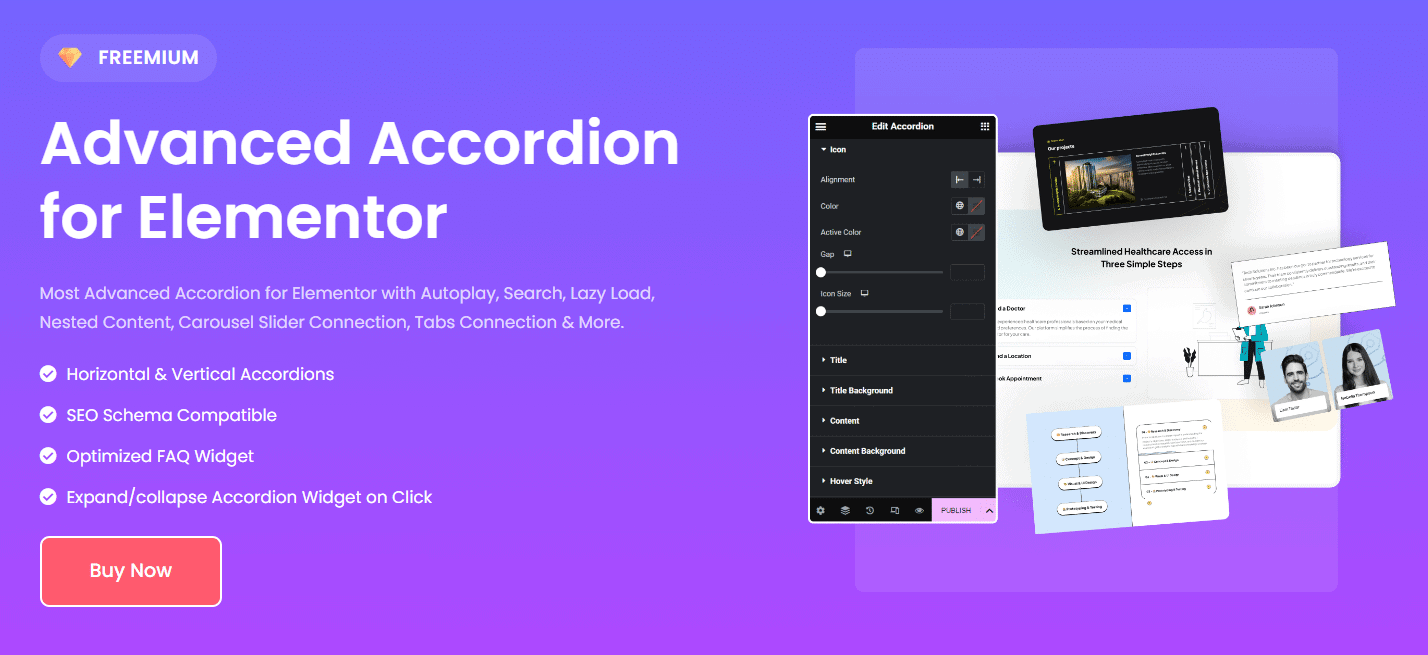
If you build with Elementor, this is the one to reach for first. Advanced Accordion is a widget inside The Plus Addons for Elementor, so the FAQ section lives in the same editor as the rest of your page and inherits your design system instead of fighting it. You style questions individually, switch between horizontal and vertical layouts, and drop in images or Lottie animations where a plain accordion would feel flat.
What sets it apart from a basic accordion is the interaction depth. You can link the accordion to a carousel so clicking a question reveals a matching slide, autoplay through questions like a guided tour, and add a built-in search bar so visitors filter to their question on long FAQ pages.
Best for: Elementor sites that want the FAQ to look like part of the page, not a plugin bolted on. It ships inside The Plus Addons for Elementor, which has 100,000+ active installs on WordPress.org.
Where It Stands Out
- Deep styling control over layout, borders, animations, and pagination, so the section matches the page rather than a generic template.
- Image and slider support inside each answer, useful for product FAQs that need a visual.
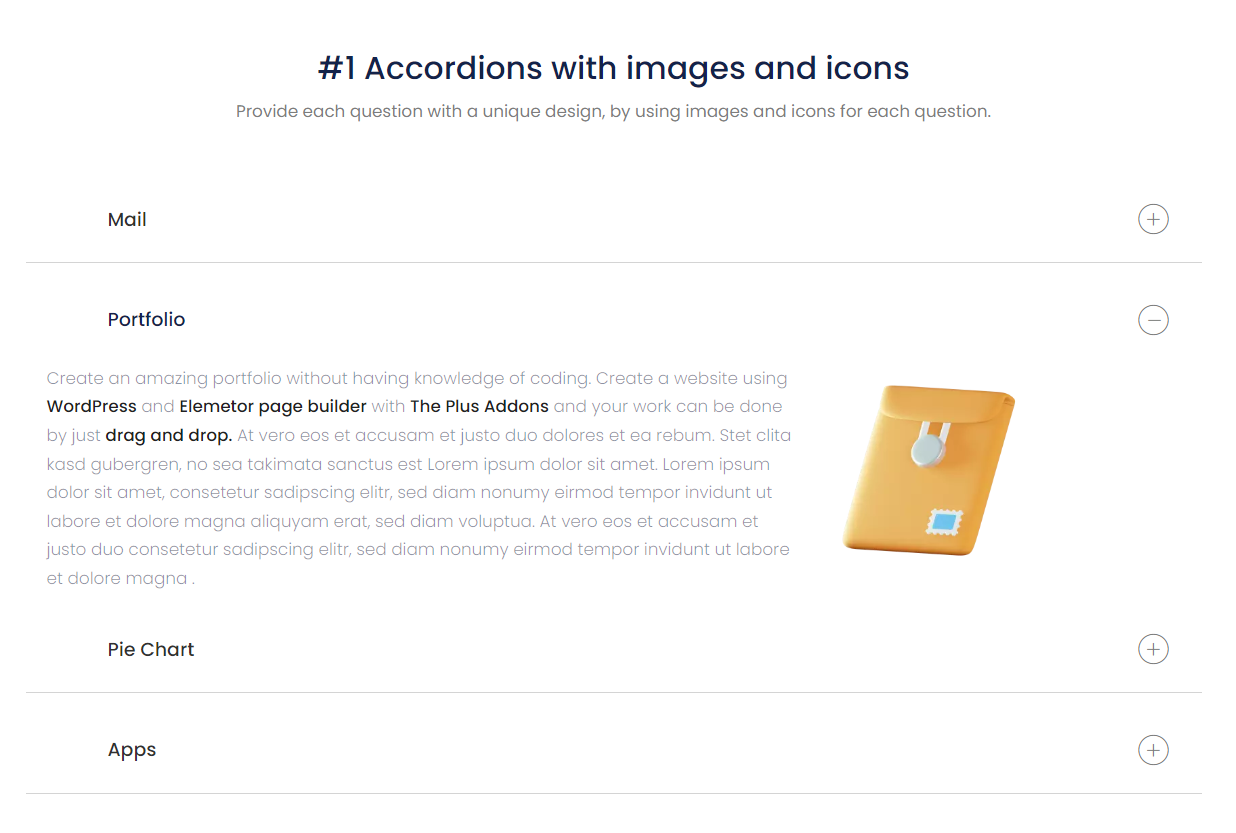
- Carousel linking, so an accordion click drives a connected carousel to the matching slide.
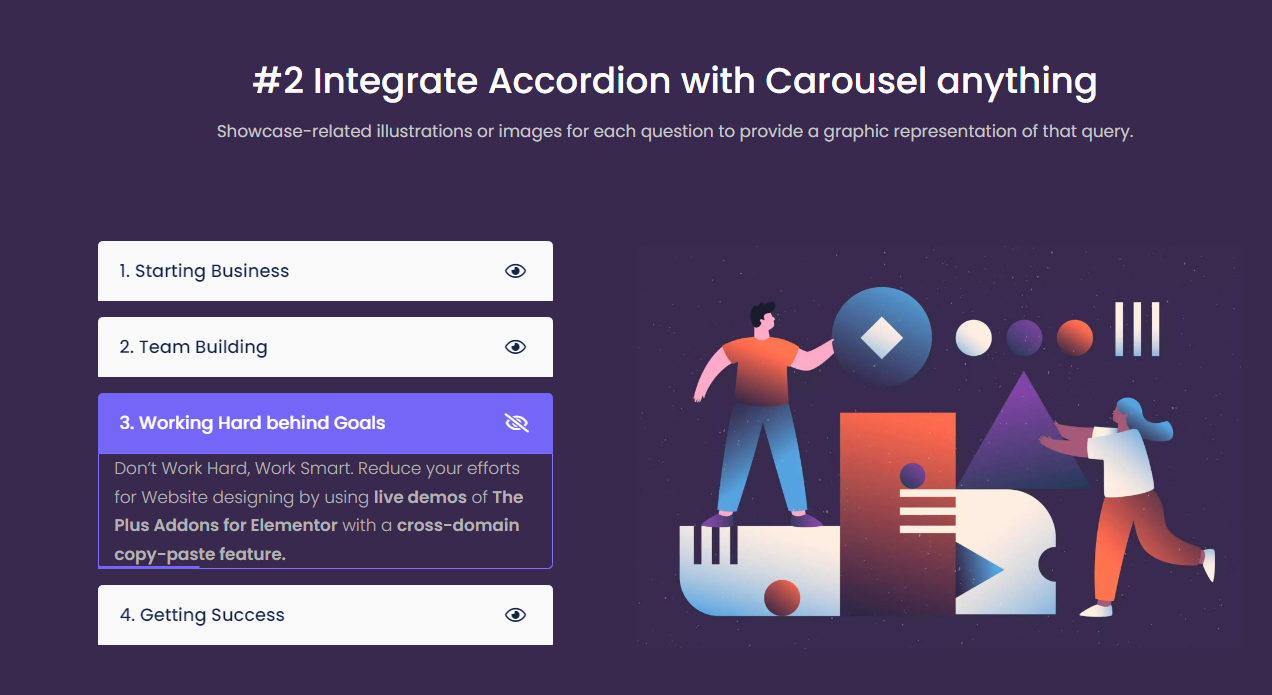
- Autoplay to cycle through questions automatically, and an integrated search bar for long lists.
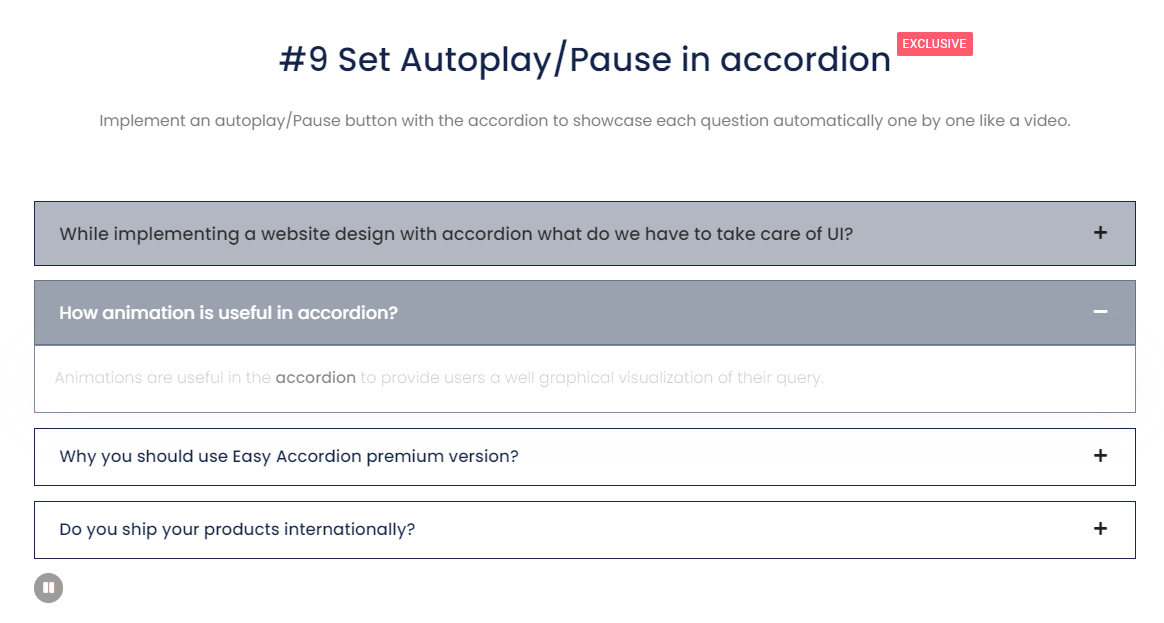
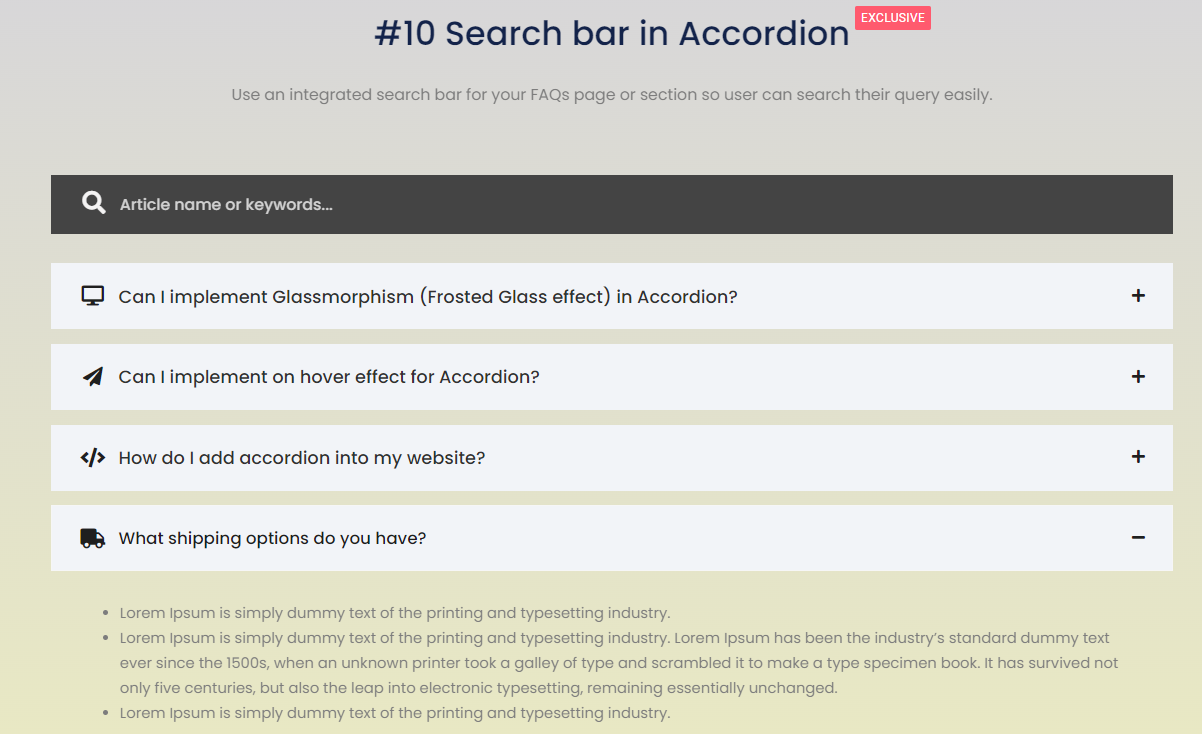
Ready-to-Use Q&A Templates
The feature that saves the most time is the live cross-domain copy-paste. Instead of building an FAQ block from scratch, you copy a finished accordion template straight from the Advanced Accordion widget page and paste it into your own editor, then swap the content. To turn it on: go to The Plus Settings > The Plus Widgets, enable cross-domain copy-paste under Plus Extras and save, then hover any template on the widget page, click Copy, and use Plus Paste in your Elementor editor.
Watch out: it is an Elementor widget, so it is the right pick when you build with Elementor. If your site is Gutenberg-only, look at Easy Accordion or Ultimate Blocks below instead.
Want to reuse Elementor designs across sites? Learn How to Copy Elementor Pages from One Site to Another for Free.
Pricing
The Advanced Accordion widget is in the free version of The Plus Addons for Elementor, available from the WordPress repository. Unlocking all 120+ widgets starts at $39/year for one site, and there is a one-time lifetime plan if you prefer to pay once.
2. All in One SEO (For the Schema, Not the Display)
Every large FAQ roundup I checked while updating this post puts All in One SEO at number one. It is the most-installed plugin in this comparison by an enormous margin, 2 million active installs against 70,000 for the next biggest, with 5,208 reviews at a 94% rating. That track record is real and worth taking seriously.
What those roundups tend not to spell out is what you actually get. AIOSEO is an SEO plugin with a schema generator, not an accordion builder. Per its own schema feature page, it supports 20+ schema types including FAQ, HowTo, Product, and Review, it lets you stack multiple types on one page (Article plus FAQ on a blog post, for example), and it validates the JSON-LD as you go. That is genuinely useful, and it is the cleanest way to get FAQPage markup onto a page without hand-writing JSON-LD.
But it will not draw the accordion. If you install AIOSEO expecting a visible, clickable FAQ section to appear on your page, nothing will happen. You still need something to build the visible Q&A, whether that is one of the accordion plugins in this list, the core Details block, or your page builder.
Best for: sites that already run AIOSEO for SEO and want FAQ schema handled in the same place, paired with a separate tool for the visible section. 2,000,000+ active installs on WordPress.org.
Where It Stands Out
- 20+ schema types with validation, so FAQPage markup is a few clicks rather than hand-written JSON-LD.
- Stacked schema on one page, which most FAQ-only plugins cannot do.
- A genuinely capable free tier covering titles, meta descriptions, sitemaps, and schema.
Watch out: it is not an FAQ display plugin, so on its own it will not put a single accordion on your site. Treat it as the schema half of the job, not the whole job.
3. Helpie FAQ
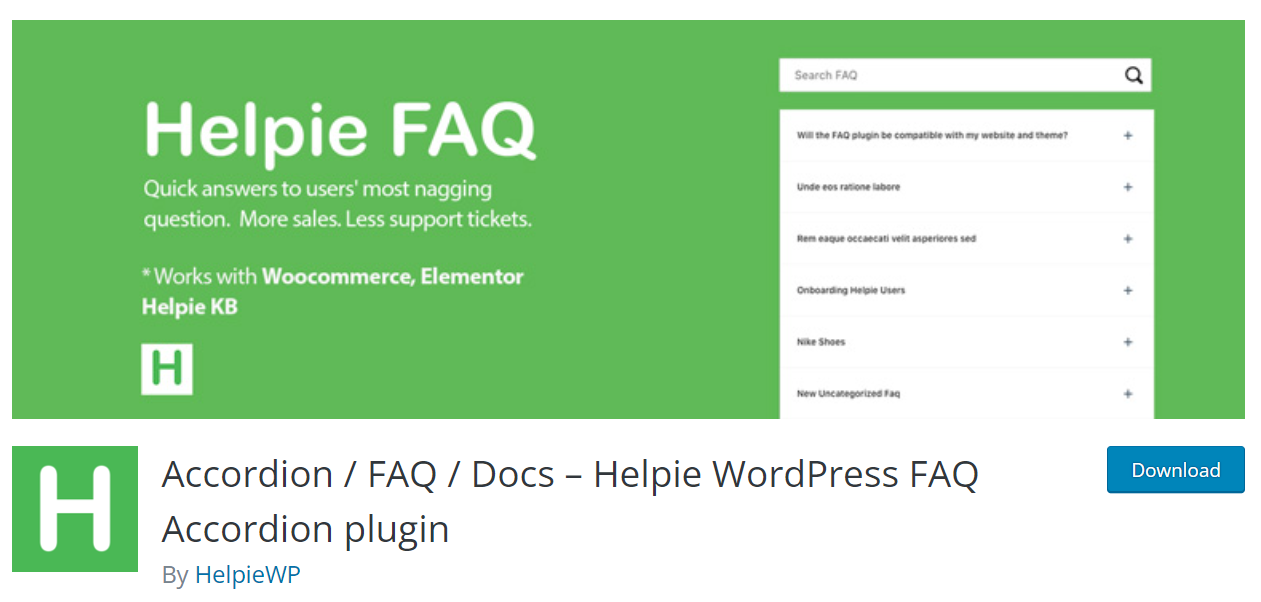
Helpie FAQ is the pick when your FAQ is closer to a small knowledge base than a short list under a product. It handles FAQs on pages, posts, or the sidebar, and its sorting and filtering (by category, recently added, or recently updated) keeps a growing library navigable instead of overwhelming.
It works with both Elementor and Gutenberg, integrates with WooCommerce for store FAQs, and is flexible enough to restyle to your brand. The built-in AJAX search is the standout for longer libraries.
Best for: a searchable, knowledge-base-style FAQ library on Elementor or Gutenberg. Around 9,000 active installs and a 90% rating from 80 reviews on WordPress.org.
Where It Stands Out
- FAQ schema built in, so search engines and AI systems can parse your content cleanly.
- Grouping, filtering, and AJAX search via shortcodes, which is what makes it suit larger FAQ sets.
- Elementor, Gutenberg, and WooCommerce compatibility, plus light and dark display options.
Watch out: for a single short FAQ under one product page, it is more tool than you need. Its strength only shows on bigger, searchable libraries.
Pricing
Helpie FAQ starts at $38.99/year for a single site with a 7-day trial, with a 5-site plan at $69 and a 100-site plan at $149.99.
4. Ultimate FAQ
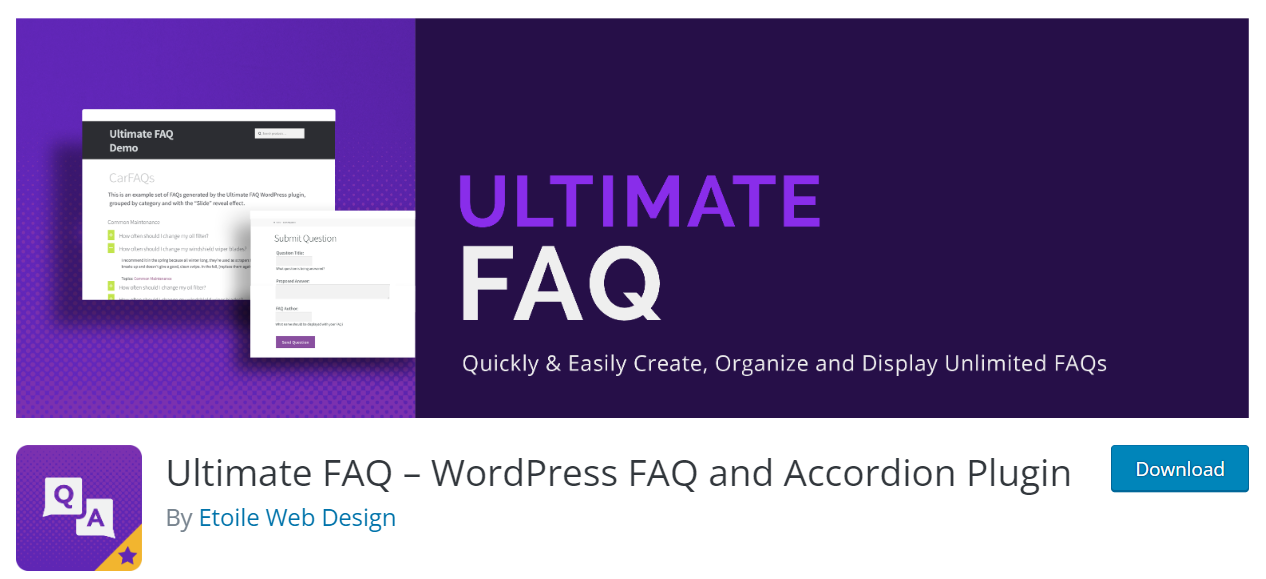
Ultimate FAQ is built for volume. If you are managing dozens or hundreds of questions across tags and categories, its organization tools and shortcode placement keep things sane, and the FAQ search bar with autocomplete helps visitors land on the right answer fast.
The feature that justifies it for bigger sites is reporting and portability: a statistics dashboard shows which FAQs get viewed, and import/export lets you bulk-load from a spreadsheet or hand the whole set to a client as a PDF.
Best for: large, categorized FAQ sets that need tags, analytics, and bulk import/export. Around 30,000 active installs and a 92% rating from 438 reviews on WordPress.org.
Where It Stands Out
- Unlimited tags and categories, the cleanest way to organize a large FAQ library.
- Statistics dashboard so you can see which questions actually get read.
- Bulk import and export, including Excel import and PDF export, and Elementor, Gutenberg, and WooCommerce support.
Watch out: the interface is functional rather than polished. You are buying organization and analytics, not design flair.
Pricing
The premium version is $67 for a single site with a 7-day trial, $127 for 5 sites, and $197 for 10 sites.
Building out full pages around your FAQs? See How to Create High-Converting Landing Pages with Elementor.
5. Accordion FAQ
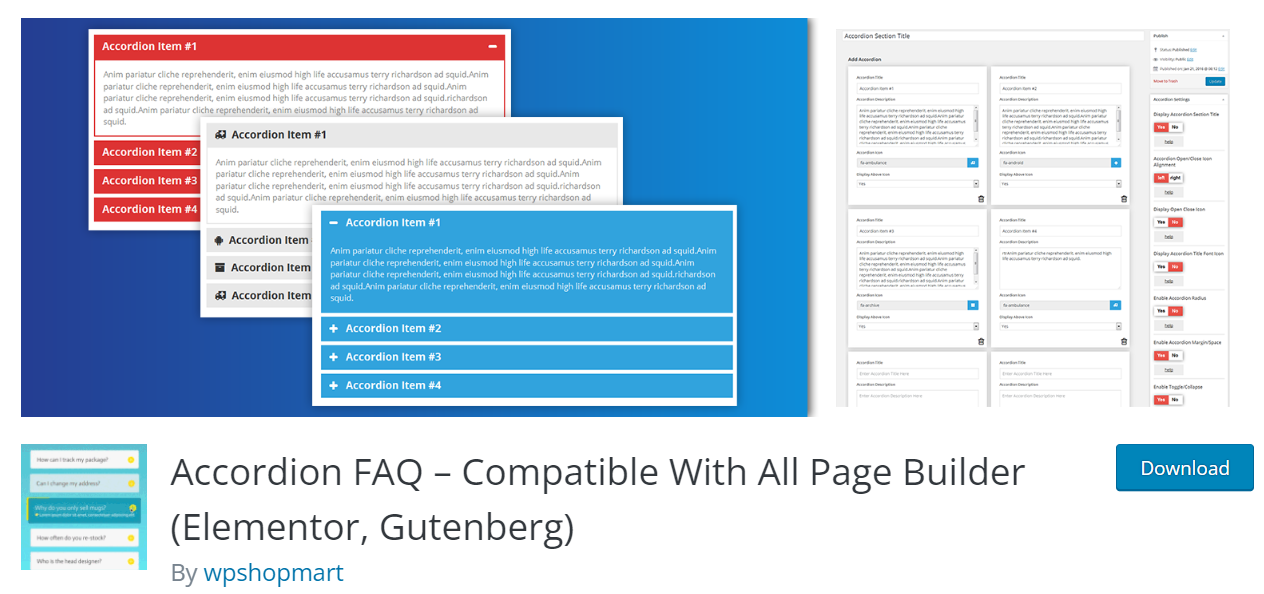
Accordion FAQ is the budget choice for people who care most about how the accordion looks. Built on Bootstrap, it leans into styling: a large library of fonts, dozens of animation styles, and plenty of color and icon options, with a list or accordion display depending on the layout you want.
It is a sensible pick for a clean, attractive single FAQ section where design matters more than heavy organization or analytics.
Best for: a good-looking single FAQ on a budget. Around 30,000 active installs and a 92% rating from 676 reviews on WordPress.org. Worth knowing: it was last updated in October 2025 and is tested only up to WordPress 6.8, two major releases behind current WordPress, so test it on staging before you rely on it.
Where It Stands Out
- Ready-made templates in the premium version to start from a polished design.
- Translation-ready output and ongoing support for setup and bug fixes.
- Extensive styling, including Google Fonts and Font Awesome icons in the pro version.
Watch out: the personal license runs on a short 6-month cycle, and the plugin is stronger on styling than on structure. For a big, categorized library, Ultimate FAQ fits better.
Pricing
Accordion Pro comes in Personal at $9 for 6 months for one site and Business at $27.
6. Easy Accordion
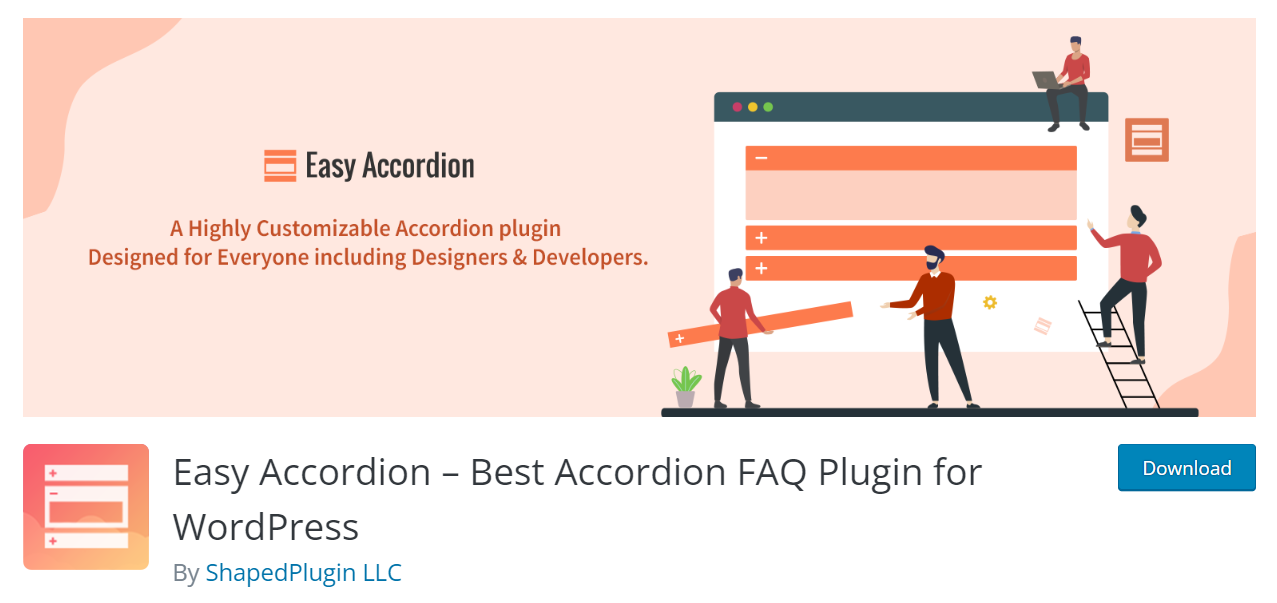
Easy Accordion is the lightweight, Gutenberg-first option. It is fast, works natively with the block editor, and still plays well with Elementor, Divi, and others, so it is a good default when you want a clean FAQ without loading a heavy plugin.
It covers the essentials well: solid styling controls, reliable responsiveness, and broad translation support, which makes it a safe pick for multilingual sites.
Best for: lightweight, Gutenberg-first sites that want a fast FAQ. With around 70,000 active installs and a 98% rating from 358 reviews, it is the most-installed dedicated accordion plugin on this list.
Where It Stands Out
- Lightweight and fast, with a drag-and-drop builder and native Gutenberg support.
- Strong styling options, including icon sets, typography, themes, and animation effects.
- Translation-friendly, compatible with WPML, Polylang, and qTranslate.
Watch out: it intentionally keeps the feature set focused. If you need carousels, analytics, or knowledge-base search, the heavier tools above suit better.
Pricing
Yearly plans start at $29/year for one site, and lifetime plans start at $129 for one site.
7. Ultimate Blocks
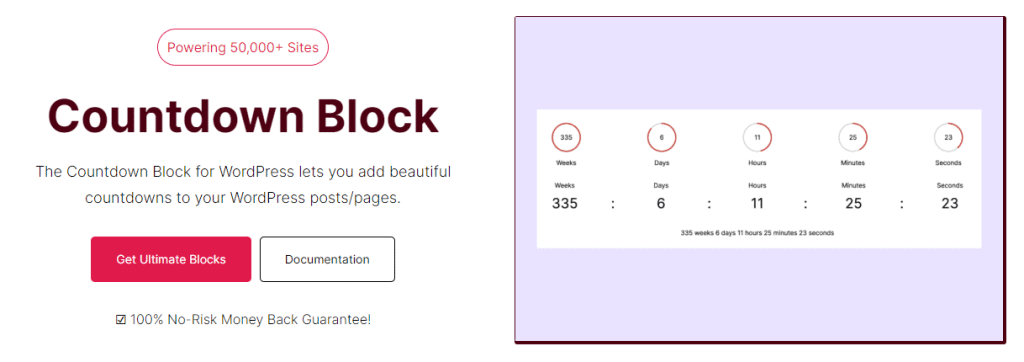
Ultimate Blocks is the choice if you are Gutenberg-native and would rather get your FAQ as one block inside a broader suite than install a single-purpose plugin. Its Content Toggle Block handles FAQs, and you get 25+ other blocks for the rest of your content in the same install.
The Content Toggle Block is more capable than it first looks: customizable icons and colors, smooth animations, default open or closed states, and nesting for multi-level structures. It keeps FAQ markup clean so search and AI engines can read it, even though the rich-result boxes are gone.
Best for: Gutenberg users who want FAQ plus 25+ other blocks in one install. Around 50,000 active installs on WordPress.org.
Where It Stands Out
- Toggle state control, including how the toggle behaves on mobile.
- Nested FAQs for complex, multi-level question structures.
- FAQ schema support and a default-open option to surface your top question first.
Watch out: FAQ is one feature in a general block suite, not a dedicated FAQ tool. If FAQs are your only need, a focused plugin gives you more control.
Pricing
Ultimate Blocks is free to try, with a premium version at $49/year for a single site.
Which WordPress FAQ Plugin Should You Choose?
Skip the feature-count comparison and pick by how you build:
- You build with Elementor: Advanced Accordion by The Plus Addons for Elementor, for the design control, carousel linking, and copy-paste templates inside your existing editor.
- You need a searchable knowledge base: Helpie FAQ, for filtering and AJAX search across a growing library.
- You manage a large, categorized FAQ set: Ultimate FAQ, for tags, analytics, and bulk import/export.
- You want design on a budget: Accordion FAQ, with the staleness caveat above.
- You are Gutenberg-first and want it light: Easy Accordion, or Ultimate Blocks if you also want a wider block suite.
- You only need the schema: All in One SEO, paired with any of the above for the visible section.
- You need three questions on a simple page: the core Details block, and skip the plugin entirely.
A note on the free question, since it comes up constantly: every plugin in this comparison has a working free version, and for a straightforward FAQ section most people never hit the paid tier. The premium plans matter when you need templates, analytics, knowledge-base search, or bulk import, not for putting a well-styled accordion on a page.
For most Elementor sites, Advanced Accordion is the one I reach for, because the FAQ ends up looking like part of the page instead of a plugin bolted on, and it comes bundled with 120+ other widgets you will use elsewhere on the build. If you are running AIOSEO already, let it handle the FAQPage schema and let the accordion handle the display. That split is the setup I end up with on most client sites.
Suggested Reading
- How to Add a FAQ Accordion in Elementor (With FAQ Schema Built In)
- 5 Best WordPress Accordion Plugins for Elementor
- Schema Markup for AI Citations in WordPress
- 5 Best Free SEO Plugins for WordPress
- 10 Best WordPress Page Builders
Further Read: Pair your FAQ work with the right SEO setup. See the 5 Best SEO Plugins for WordPress.