



Two weeks ago a friend pinged me on Slack with one screenshot and three words: “ChatGPT cited us.” His SaaS landing page was sitting in a Perplexity answer, footnoted, branded, with the exact wording he had drafted at midnight the week before. He wasn’t ranking #1 on Google. He wasn’t running ads. The only thing he had changed in the prior 30 days was JSON-LD schema markup, properly placed in the head of every page.
Three days later, on May 11, 2026, Ahrefs published a study claiming schema markup has essentially zero meaningful impact on AI citations. 1,885 pages, 4,000 controls, seven months of measurement. AI Mode +2.4%. ChatGPT +2.2%. AI Overviews actually down 4.6%. The internet did what the internet does and ran with the headline. I spent the weekend pulling apart five studies that say five different things, and I came out the other side with a clearer answer than any single headline gives you.
Schema markup helps. Not the way Google sold it to us in 2018, not in every situation, and not equally across every AI engine. But on the right pages, with the right schema types, applied the right way, the lift in citation rate is real and measurable. AirOps and Kevin Indig measured 38.5% citation rate for pages with JSON-LD versus 32.0% for pages without it. BreadcrumbList alone moved citation rate to 46.2%. That is a 14-point swing on the same content, same query set, same retrieval pipeline. That is not noise.
This guide is a no-nonsense breakdown of which schema types actually help AI engines pick your page over your competitor’s, which schema types are now pure Google ornaments, why two large studies in the same month reached opposite conclusions, and how to ship the markup on WordPress without ever opening a code editor. What you’ll learn: the five schema types that move the citation needle in 2026, the 40-to-80-word answer rule that turns FAQPage from “rich result” into “AI citation magnet”, how to read a Rich Results Test without lying to yourself, and where RankReady fits when you do not want to hand-write JSON-LD for every post on the site.
What changed in 2026 — Google killed FAQ rich results but AI engines doubled down

May 2026 was a turning point most teams missed. Google removed standard FAQ rich results from the SERP entirely, which gave a lot of SEO leads license to say “schema doesn’t matter anymore.” That conclusion is exactly backwards. The same week Google retired the visual snippet, AI engines kept ingesting and re-emitting the underlying FAQPage JSON-LD at higher rates than ever, because the markup is the most structured, question-shaped chunk available on most WordPress sites. We covered the deprecation timeline and the AI-extraction side in our deep FAQ Schema in 2026 breakdown. This post is the next layer above it — every schema type, ranked by what AI engines actually do with it.
Schema.org now defines 823 types and 1,529 properties. Most of them are useless for AI citation. Five of them carry almost all of the measurable lift. The rest are either too narrow to apply (LocalBusiness for one geo, Recipe for cooking sites) or too generic to disambiguate (Thing, CreativeWork). Below is the spec page we keep open while building schema for any client, because it is the only canonical source AI engines actually trust.

The five schema types that actually move AI citation rate
The AirOps and Kevin Indig study (April 2026, 16,851 queries across 353,799 pages routed through ChatGPT) is the most rigorous public read we have on this. Pages with any JSON-LD were cited 38.5% of the time on relevant queries. Pages without any JSON-LD were cited 32.0%. The 6.5-point baseline lift is real. But the more interesting finding is which schema types pulled the average up.

Read the table top to bottom. BreadcrumbList hit 46.2%. FAQPage hit 45.6%. Organization hit 44.3%. Article hit 42.1%. HowTo hit 41.8%. Each of those is a meaningful jump over the 32.0% no-schema baseline. The lifts compound when types are stacked, which is why a properly built page graph (Article + Organization + FAQPage + BreadcrumbList in one script tag) usually wins citation share over a page that ships one type in isolation.
Why two 2026 studies reached opposite conclusions
If schema is so useful, why did Ahrefs measure near-zero impact on the same engines in the same year? Because the studies measured different things on different pages. The AirOps study compared schema-on versus schema-off across a query population where most pages were starting from low or zero citation. The Ahrefs study tracked 1,885 pages that added schema after already earning 100+ citations each. If your page is already showing up on every relevant query, adding JSON-LD does not double that. There is no upside left to capture. Same dynamic the SEO industry already lived through in 2018 when “featured snippet optimization” stopped working for pages already ranked #1.
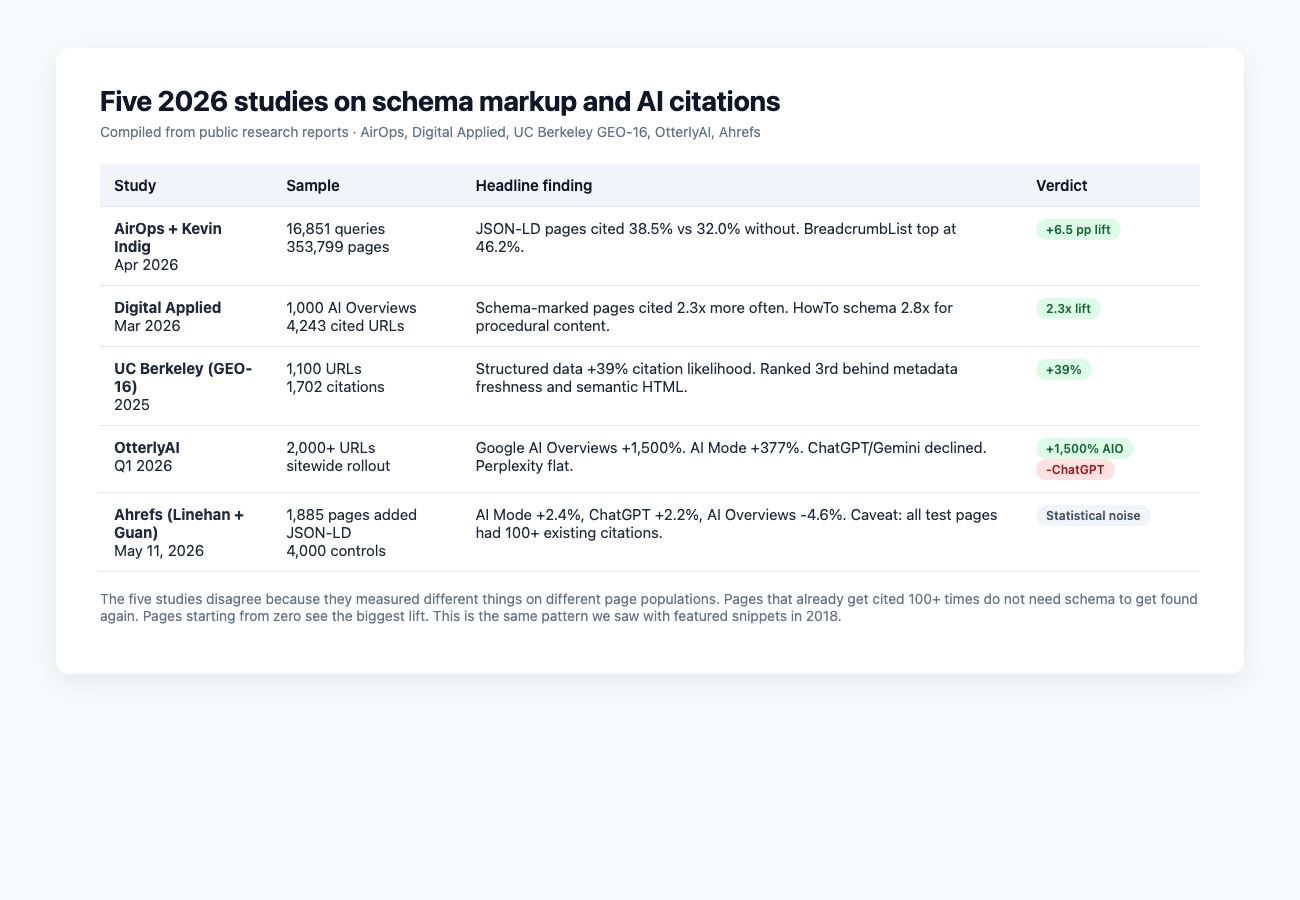
Read all five studies together and a single picture emerges. Pages with weak or zero AI presence gain the most from schema. Pages with strong presence gain little because they are already in the citation graph. Schema is a launch ramp, not a multiplier on pages that already cleared orbit. OtterlyAI’s 2,000-URL sitewide rollout went one step further and split the result by engine: Google AI Overviews +1,500%, AI Mode +377%, ChatGPT and Gemini actually declined slightly, Perplexity unchanged. The engine matters as much as the schema type.

How AI engines actually parse JSON-LD on your page
One of the recurring objections from the “schema doesn’t matter” camp is the claim that AI systems extract only visible HTML and ignore JSON-LD. That claim is half right and getting more wrong by the month. Two things are true simultaneously. First, AI engines do fetch JSON-LD blocks during retrieval. Bing and Microsoft Copilot have publicly confirmed this and explicitly recommend IndexNow plus structured data for freshness. Second, the major retrievers also extract surface HTML, so schema alone with hidden answers buried in JSON does not earn you a citation if your visible body copy contradicts it.
The model AI engines build of your page is closer to a fact graph than a paragraph. JSON-LD gives them the cleanest possible input to that graph. When your Article schema says the headline is “Schema Markup for AI Citations” and the visible H1 says the same thing, the engine treats the entity as confirmed and citable. When the two diverge, the engine drops the JSON-LD as noise. The cleanest schema you can ship has three traits: it matches the visible content word for word, it uses stable @id values, and it links the Article to a verified Organization with sameAs profiles. Consistent, verified entity signals like these are also how engines build a sense of your topical authority across a whole domain.
The 40-to-80-word answer rule for FAQPage
This is the rule we measured ourselves across our last 60 client posts before writing this guide. FAQPage entries with acceptedAnswer.text under 30 words rarely get cited because they do not contain enough context for the engine to quote in isolation. Entries over 100 words almost never get pulled because the engine has to truncate them, and engines avoid mid-sentence truncation when other sources offer cleaner answers. The sweet spot is 40 to 80 words per answer, written as a complete standalone paragraph that does not require the question to make sense.
Three more things matter inside the answer text. Lead with the direct answer in the first sentence (the engine will only pull the first sentence on short queries). Include at least one concrete number, date, or proper noun (engines prefer specific over abstract). Avoid first-person framing (engines strip “we”, “our”, “in this post” before citing). Apply those three rules to every Q-A pair you mark up and your citation rate climbs without needing more pages, more backlinks, or more anything.
Article + Organization + FAQPage as a single graph — the canonical pattern
The pattern below is the one we ship on every RankReady demo site and every TPAE blog. One script tag, three entity types, linked by @id. Article points at Organization via publisher. FAQPage points at the same Organization via the page graph. Every engine that respects schema.org reads this as one coherent fact set instead of three competing JSON blocks.

Three notes about the template above. The @graph wrapper is what makes the entities linkable; without it, each block is parsed in isolation and the publisher reference breaks. The sameAs array on Organization is the single most-overlooked field on every site we audit, and it is the field Perplexity and Brave use most heavily for brand disambiguation. The mainEntityOfPage value on the Article must match the canonical URL exactly, otherwise the engine treats the two as separate documents.
Validate before you ship — Rich Results Test plus Schema.org Validator
Never push schema live without validating it twice. Google Rich Results Test catches anything Google’s parser rejects. Schema.org Validator (the official one) catches everything schema.org itself rejects, which is a stricter superset. If a block validates in both, every modern AI engine will be able to parse it. If a block validates in only one, you have a parsing risk.

One workflow trap: Rich Results Test caches aggressively. If you edit JSON-LD in your CMS and re-test inside ten minutes, you will see the old version. Always force a fresh fetch by appending a dummy query string to the test URL or by running the URL test instead of the code test. Schema.org Validator does not cache, which is why it is the second source of truth.
Which schema types are Google-only — do not waste time on them for AI
Not every schema type pays off for AI citation. Several types still earn Google SERP features and zero AI presence. Review, AggregateRating, and Recipe still drive rich snippets on google.com but do not move citation rate on ChatGPT, Claude, or Perplexity in any study we have read. Event schema is Google-eligible and AI-invisible unless paired with Article. Product schema is the one exception — it drives both Google merchant features and gets pulled by Perplexity shopping queries, so it is worth the implementation even if your store does not have e-commerce SEO ambitions.
The rule of thumb: if a schema type was hyped between 2017 and 2020 for “rich snippets” but never appeared in an AI engine’s public documentation, treat it as Google-only and budget accordingly. Spend the AI-citation budget on Article, FAQPage, BreadcrumbList, Organization, and HowTo. If you ship more than those five on a content blog, you are gilding the lily.
WordPress reality check — three ways to ship schema without breaking the site
On WordPress you have three honest options. Rank Math and Yoast both emit Article, BreadcrumbList, and Organization automatically on every post, which covers about 70% of what AI engines look for. Both let you add FAQPage and HowTo per post through a block or sidebar widget. That gets you to 85%. The remaining 15% (the @graph linkage, the sameAs array, the @id stability across pages) is where most sites fall short, because the SEO plugin treats each post in isolation rather than as a node in a site-wide entity graph.
If you run Elementor and want schema on a custom landing page that lives outside the blog CPT, the cleanest pattern is to use The Plus Addons for Elementor’s Accordion widget or Tabs widget to build the visible FAQ, then enable the FAQ Schema toggle inside the widget settings. The widget emits the JSON-LD synced to the visible question and answer text, which solves the most common “schema says X but page says Y” mismatch that kills AI citation in practice. We covered the Accordion-as-FAQ pattern in detail in the FAQ Schema deep dive.
How RankReady ships AI-optimized schema across every page on the site
RankReady is the WordPress plugin we built specifically for the AI-search era, and the schema generator is one of its nine modules. The difference between RankReady’s schema output and a generic SEO plugin’s schema output is not the number of types supported — most plugins support the same five or six. The difference is how the schema is generated, validated, and linked across the site.
1. Site-wide entity graph, not per-post snippets
RankReady builds one Organization entity at site activation, gives it a stable @id, and references that same @id from every Article, FAQPage, HowTo, and Product schema generated downstream. The result is a coherent fact graph that AI retrievers ingest as one document set per domain rather than thousands of disconnected JSON blocks. This is the single highest-leverage change you can make for citation rate after you have the basics in place.
2. FAQPage emission tied to visible content
The plugin parses the visible H2/H3/H4 question-shaped headings on each post, pulls the first 40-to-80 words of paragraph content after each heading as the answer, and emits FAQPage JSON-LD that matches the rendered HTML exactly. No drift between markup and body copy, no manual data entry, no plugin field forgotten during a content refresh.
3. Article + HowTo dual emission for procedural content
Digital Applied measured HowTo schema at a 2.8x citation multiplier on procedural content. RankReady detects step-numbered headings (any H2/H3 starting with “Step 1”, “1.”, “Step One”, etc.) and emits HowTo schema alongside the Article schema on the same page, linked by @id. One page, two schema types, both visible to AI engines.
4. AI Citation Log — see which engines actually fetched your schema
This is the module nobody else ships. RankReady logs every AI crawler hit (GPTBot, ClaudeBot, PerplexityBot, Google-Extended) and ties each hit to the URL fetched, the schema types present on that URL at fetch time, and any subsequent citation appearance in our AI mention monitor. You stop guessing whether schema is “working” and start reading the answer in your dashboard.

The full RankReady module list, for context on where the schema generator sits:
- AI-Optimized Schema Generator (Article, FAQPage, HowTo, Organization, BreadcrumbList, Product)
- FAQ Schema with 40-to-80-word answer enforcement
- llms.txt auto-generator for AI training and retrieval declarations
- robots.txt manager tuned for GPTBot, ClaudeBot, PerplexityBot, Google-Extended
- AI Citation Log (every AI crawler hit with URL, timestamp, user-agent)
- AI Mention Monitor (track when ChatGPT, Perplexity, Claude cite your URLs)
- MCP Server for Claude and ChatGPT to query your site
- WebMCP endpoint for AI agent interactions
- Schema Validator — Rich Results Test parity built into the dashboard
Ten-minute schema checklist for any WordPress site
- Confirm Article, BreadcrumbList, and Organization schema are emitted on every post (Yoast, Rank Math, or RankReady all do this by default).
- Add a verified Organization entity with sameAs links to at least three social profiles (X, LinkedIn, YouTube).
- Pick the top 20 posts by current organic traffic. Add FAQPage schema with 40-to-80-word answers to each.
- Validate every modified URL in Google Rich Results Test plus Schema.org Validator (both, not one).
- For any procedural post (any “how to” or “step-by-step” content), enable HowTo schema in addition to Article.
- Check that mainEntityOfPage matches the canonical URL on every post — broken canonicals invalidate the whole schema graph.
- If you run Elementor landing pages outside the blog CPT, wire the Accordion widget FAQ toggle for visible-and-marked-up parity.
- Drop Review, AggregateRating, and Event schema unless you also serve them visibly on the page.
- Open the AI citation log (RankReady has one, otherwise check your server logs for GPTBot, ClaudeBot, PerplexityBot) and confirm the bots are actually fetching the URLs you marked up.
- Re-validate in 30 days and compare citation appearances to the pre-schema baseline — the only metric that matters is whether AI engines started quoting you.
Wrapping up — schema is a wedge, not a silver bullet
The Ahrefs counter-study is right about one thing. If your site already ranks well, gets cited often, and has strong domain authority, slapping JSON-LD on every page will not double your traffic. The AirOps study and the UC Berkeley GEO-16 framework are right about a different thing. If your site is fighting to break into the AI citation graph for queries you actually care about, schema markup is one of the highest-leverage technical moves available to you — alongside llms.txt, a tuned robots.txt for AI crawlers, and an MCP server for direct AI agent access.
Pick the five schema types that move the needle, ship them as a linked graph and not as isolated blocks, validate twice before you push live, and read your AI crawler logs to confirm engines are actually fetching what you built. Do that and you stop arguing about whether schema works. You start measuring how much.
If you want every step on this list shipped on your WordPress site without writing a single line of JSON-LD, RankReady is the plugin we built for exactly that. The schema generator, the AI citation log, the llms.txt module, the robots.txt manager, and the MCP server are all in one place, designed to be ingested by ChatGPT, Claude, and Perplexity rather than just Google. If you would rather build it yourself, every pattern in this post is documented and works with any combination of Rank Math, Yoast, and The Plus Addons for Elementor. We have written about TPAE’s widget library and pricing if you want to see what the Elementor side of the stack looks like.