



You have styled a testimonial block, a CTA, or a service box exactly how you want it, and now it needs to appear on fourteen pages. Copying it fourteen times works right up until the phone number changes and you have to hunt down every copy. Elementor’s Global Widget exists for precisely that problem: save the widget once, drop it anywhere, and edit every instance from one place.
This guide covers creating one, the three ways to insert it, editing and unlinking, deleting it properly, and the part most tutorials skip: what to do when a global widget stops showing up. It also settles the question people ask most often, which is how a global widget differs from a template, because Elementor’s own answer to that is more interesting than you would expect.
Key Takeaways
- Global Widgets are an Elementor Pro feature. The free version does not include them.
- Right-click a widget handle, choose Save as a global, and it appears under the Globals tab in the panel.
- Editing the global updates every instance on the site. Unlink an instance first if you want to change just one.
- Global widgets are stored as templates, which is why you delete them from WP Admin and why they also get a shortcode.
- Save as Global applies to a single widget. For a whole section, save it as a template instead.
What a Global Widget Actually Is
Per Elementor’s own documentation, a Global Widget gives you control over a single widget that appears in multiple places on your site, and editing it in one place instantly updates the rest. That is the whole idea. You are not copying a design, you are creating one source and pointing many pages at it.
Two constraints are worth knowing before you start. First, this is a Pro feature. If you are on free Elementor, the Save as a global option will not be in your right-click menu. Second, it operates at the widget level, not the section level, which trips up a lot of people and is covered further down.
Where It Earns Its Keep
- Anything with details that change: a phone number, an address, an opening-hours block, a seasonal promo badge.
- Conversion elements you A/B by hand, like a CTA whose wording you want to swap sitewide in one edit.
- Client sites where someone non-technical will maintain the content and should not be editing fourteen pages.
Were you aware that certain hosting providers specifically cater to Elementor users? Check out the 5 Best WordPress Hosting for Elementor.
Global Widget vs Template: What Is the Difference?
This is the most common point of confusion, and the honest answer is that the two overlap more than the naming suggests. Elementor’s documentation gives the game away in the section on deleting: global widgets are templates. That is why deleting one happens in WP Admin rather than in the editor, and why every global widget also gets a shortcode.
So the practical distinction is about scope and workflow, not about two unrelated systems:
| Global Widget | Template | |
|---|---|---|
| Scope | One widget | A section, a page, or a whole layout |
| How you create it | Right-click the widget handle, Save as a global | Save the container or page as a template |
| Where it appears | Globals tab in the editor panel | Template library, or the Template widget |
| Edits propagate | Yes, to every linked instance | Depends on how you insert it |
| Stored as | A template | A template |
The rule of thumb: if it is one widget, save it as global. If it is a hero, a footer band, or anything made of multiple widgets inside a container, save it as a template and insert it with the Template widget instead. Trying to force a whole section through Save as a global is the single most common reason people conclude the feature is broken when it is working exactly as designed.
How to Create a Global Widget

Step 1: Build and Style the Widget First
Drop the widget onto any page and finish it properly before you save it. This can be a core Elementor widget or one of the advanced widgets from The Plus Addons for Elementor. The example here uses the Animated Service Box widget with hover styling applied.
Finishing it first matters more than it sounds. Every instance you place later inherits this state, so the tidier the starting point, the less cleanup across the site.
Step 2: Save It as a Global
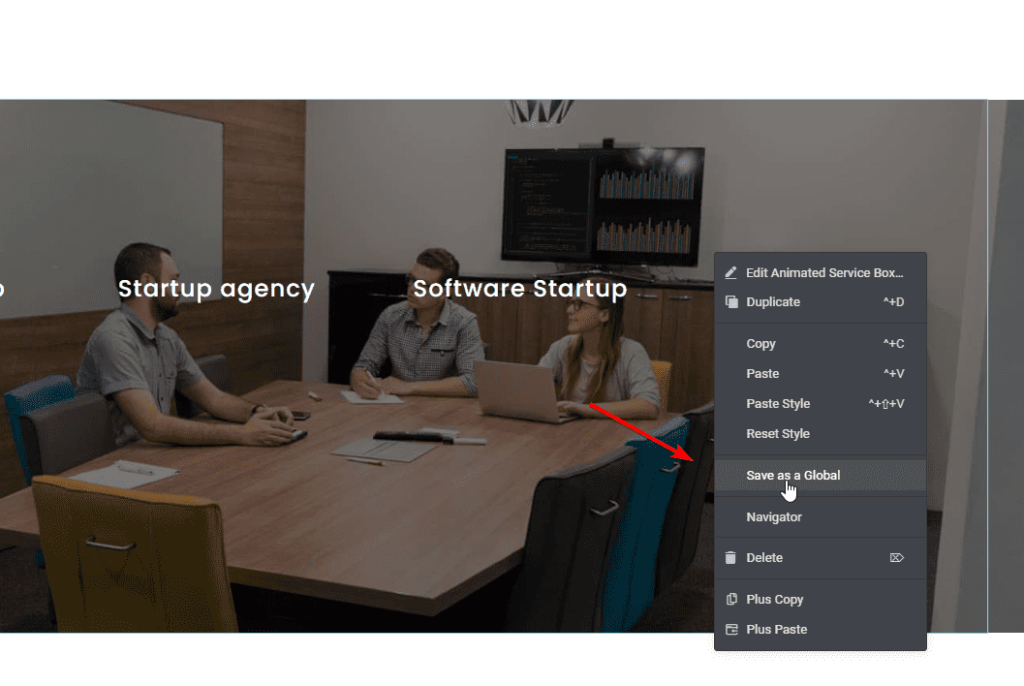
Right-click the widget’s handle and choose Save as a global. Elementor prompts you to name it, so give it something a colleague would recognise six months from now, for example CTA, primary, green rather than global 2. Click Save and it becomes available in the panel under the Globals tab.
Did you know you can build Elementor sites offline as well? Check our Step-by-Step Guide on How to Install Elementor in Localhost.
Three Ways to Insert a Global Widget
Method 1: From the Globals Tab
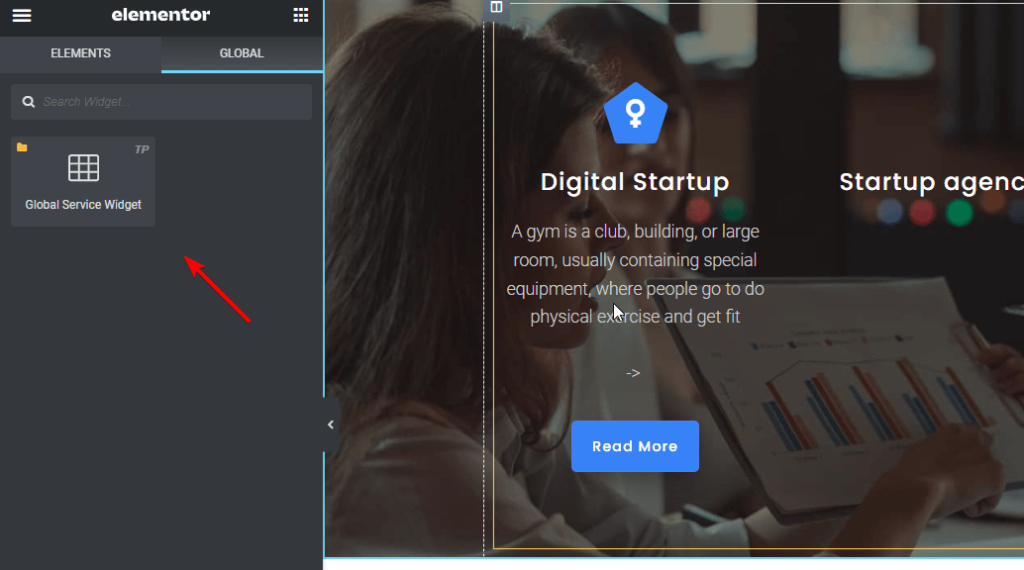
Open the page with Elementor, click Globals in the panel, and drag your saved widget onto the canvas. This is the normal route and the one you will use most.
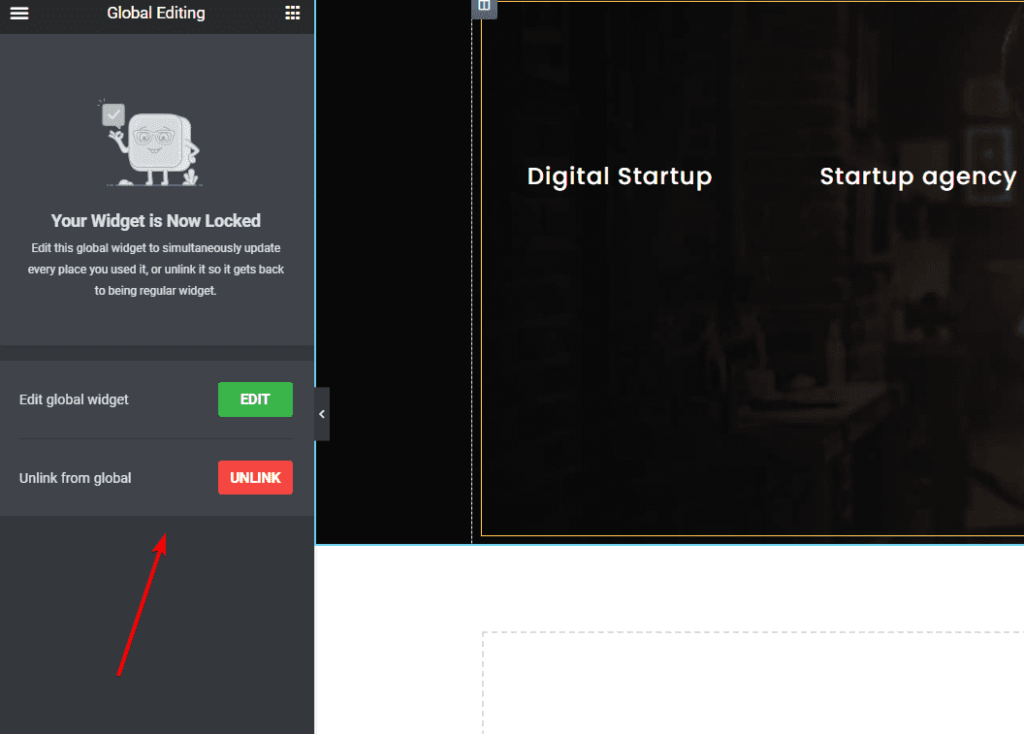
As soon as it lands, two controls replace the usual editing options: Edit global widget and Unlink from global. Those two are the whole behaviour model, so it is worth understanding both before you start clicking.
Method 2: From the WordPress Widgets Panel
For a sidebar or footer that is not built in Elementor, go to Appearance then Widgets, and use the Elementor Library widget. Drop it into the widget area, choose your saved global, and save. This is how you get an Elementor-designed element onto parts of the site Elementor does not control.
Method 3: With a Shortcode
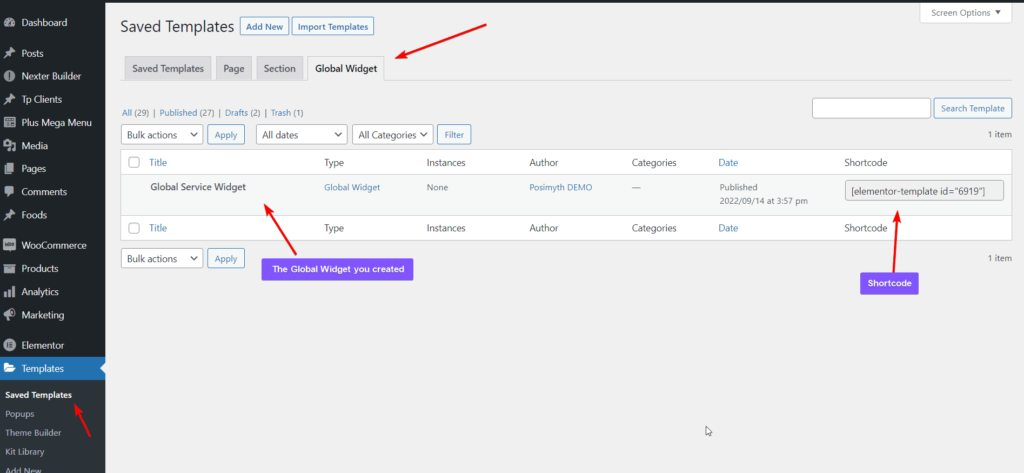
Because a global widget is stored as a template, it is assigned a shortcode automatically. Find it under Templates, copy the shortcode, and paste it wherever shortcodes run: a Gutenberg shortcode block, a classic editor post, or a theme area. This is the route for pages that are not Elementor-editable at all.
Editing and Unlinking
Click Edit global widget and you are editing the source. Elementor warns you about this for good reason: the change lands on every instance across the site the moment you save. That is the feature working, but it is also the way people accidentally rewrite a CTA on forty pages during what they thought was a one-page tweak.
Unlink from global is the escape hatch. It detaches that one instance so you can change it freely, and from then on it neither affects nor receives updates from the global. Use it when a single page needs different wording but the same design.
Unlinking is one-directional. There is no relink button, so if you unlink by mistake, you delete that instance and drag a fresh copy from the Globals tab.
How to Delete a Global Widget
You cannot delete a global widget from inside the editor. Because they are stored as templates, Elementor’s documentation directs you to WP Admin: open your templates list, find the global widget by the name you gave it, and move it to Trash. Bulk actions work here if you are clearing out several at once.
Check where it is still in use before you delete. Removing the source removes the widget from every page that was displaying it, and there is no warning listing which pages those are.
Global Widget Not Working? Start Here
This is the part most guides leave out, and it is what people actually search for once the happy path stops working.
Save as Global Is Missing From the Right-Click Menu
Almost always an edition problem: Global Widgets are Pro-only, so on free Elementor the option simply is not there. Confirm Elementor Pro is installed and activated with a valid licence, since an expired licence can pull Pro features. Also make sure you are right-clicking the widget’s own handle rather than the container around it.
The Widget Vanishes From the Front End
If it renders in the editor but not for visitors, regenerate CSS and clear caches first, in this order: Elementor’s own regenerate-files tool, then your caching plugin, then your host’s server cache, then the CDN. Global widgets are rendered from the template, so a stale cached copy of a page can keep serving an older state for a surprisingly long time.
There is also precedent for version-specific bugs here. An issue filed on Elementor’s GitHub repository reported global modules disappearing from Theme Builder templates after a 3.25.1 update. If the disappearance started immediately after an Elementor update and caching is ruled out, check the current issue tracker before rebuilding anything by hand.
Editing One Instance Changed Them All
Working as designed. You clicked Edit global widget rather than Unlink from global. Restore the correct content on the global, then unlink the one instance that needed to differ and edit it separately.
Can You Save a Container as a Global Widget?
Not through Save as a global, no. Elementor’s documented behaviour covers saving an individual widget, and a container full of widgets is a different object. Save the container as a template instead, then place it with the Template widget. You get the same reuse, managed from the template library rather than the Globals tab.
Wrapping Up
Global Widgets solve one specific problem well: a single widget that has to look and read the same in many places, and has to be editable from one spot. Save it once, insert it from the Globals tab, edit the global when everything should change, and unlink the rare instance that should not.
Keep the scope rule in mind and most of the frustration disappears: one widget goes global, a whole section becomes a template. And if a global widget stops rendering, work through caching before you assume the feature is broken, because that is what it usually turns out to be.
If you are an Elementor user, The Plus Addons adds 120+ widgets you can save as globals the same way, from advanced service boxes to carousels and pricing tables.
Suggested Reading
- How to Display Elementor Templates Using a Shortcode
- How to Copy Elementor Pages from One Site to Another
- Elementor CSS Not Loading: How to Fix It
- 5 Best WordPress Hosting for Elementor
Further Read: Did you know you can improve the user experience on your site by adding jump anchor links? Learn what they are and How to Add Elementor Jump to Section With Anchor Links.