






Elementor’s built-in Image Gallery and Image Carousel widgets open every image in a lightbox. There is no setting to assign a different destination URL to each image. Every click triggers the same zoom-in modal, regardless of which image was clicked.
For portfolios, product showcases, and service image galleries, this is a real limitation. You need each image to point somewhere specific, a project page, a product page, a case study.
The Gallery Listing widget from The Plus Addons for Elementor by POSIMYTH solves this. The widget is available on the free plan. The Repeater Mode (which enables per-image custom links) and the Carousel Slider layout both require the Pro plan.
You add each image individually and assign it a unique link, title, description, and category. No custom code or PHP hooks required.
Quick answer: Elementor’s native gallery and carousel cannot send each image to a different URL. To do it without code, add the Gallery Listing widget from The Plus Addons for Elementor, switch it to Repeater Mode, and paste a Custom Link into each image row.
The steps below reflect The Plus Addons for Elementor 6.4 on Elementor 4.x and WordPress 7.
Common use cases for per-image gallery links:
- Portfolio galleries where each image links to a project page
- Service image carousels that link to individual service pages
- Product image galleries linking to individual product pages
- Client work galleries directing visitors to case study pages
Why Elementor’s Default Gallery and Carousel Widgets Don’t Support Per-Image Links
Elementor’s Image Gallery widget uses a bulk upload system. You select all images at once from the WordPress media library. Because images are added in a single batch with no individual content fields, there is nowhere to assign a separate URL to each one.
The only available link setting applies to the entire gallery: open lightbox, open media file, or a single custom URL for all images.
The Image Carousel widget has the same limitation. You can set one global link behavior for the entire carousel, but not a different URL per slide.
Some developers work around this by modifying the link_to control using Elementor PHP filters. That approach works but requires code that needs to be updated with each major Elementor release.
The no-code alternative is the Gallery Listing widget from The Plus Addons for Elementor, which adds individual link fields per image through its Repeater Mode (Pro feature).
In current versions, the Repeater Mode option appears as a Gallery Type dropdown in the Content tab and immediately reveals per-image fields for link, title, description, category, and hover icon.
| Feature | Elementor Native Gallery | Gallery Listing Widget (The Plus Addons) |
|---|---|---|
| Per-image custom link | No | Yes, one URL per image (requires Repeater Mode, Pro) |
| Image upload method | Bulk selection | Bulk (Free) or individual repeater items (Pro) |
| Per-image title and description | No | Yes (requires Repeater Mode, Pro) |
| Category-based filter tabs | No | Yes, with Ajax |
| Multiple layout options | Grid only (Gallery) / Slider only (Carousel) | Grid, Masonry, Metro (Free) + Carousel (Pro) |
| ACF dynamic gallery | No | Yes (Pro only) |
How to Add a Custom Link to Each Gallery Image in Elementor
The Gallery Listing widget (Pro) replaces the bulk-upload approach with a repeater format. Each image gets its own row with individual content fields, including a dedicated custom link field. Here is how to set it up.
Requirements: The Plus Addons for Elementor with a Pro plan ($39/year for 1 site). The Gallery Listing widget itself is available on the free plan, but the Repeater Mode (needed to add custom links per image) and the Carousel Slider layout both require Pro.
Elementor Free is sufficient. Elementor Pro is not required.
Step 1: Install and activate The Plus Addons for Elementor (Pro)
Install the plugin from your WordPress dashboard under Plugins > Add New.
Activate your Pro license under The Plus Addons > Dashboard. Once activated, go to The Plus Addons > Widgets and confirm the Gallery Listing widget is toggled on.
It may be disabled by default on fresh installs.
Step 2: Open your page in Elementor and add the Gallery Listing widget
Edit your page in Elementor. In the widget panel, search for “Gallery Listing” and drag it onto your layout. You will see a default grid with two placeholder image items.
Step 3: Switch to Repeater Mode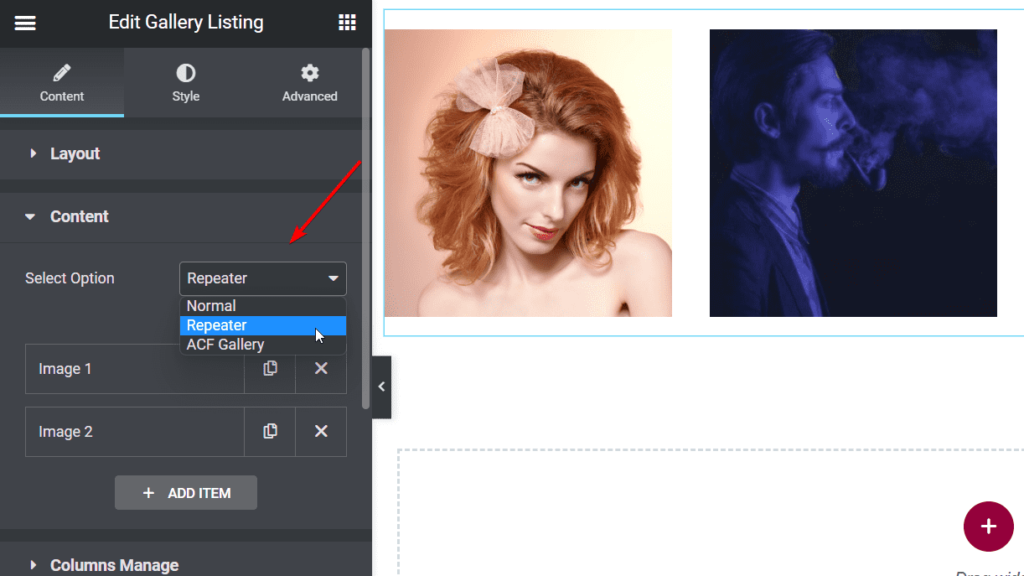
In the Content tab, find the Gallery Type option and select Repeater Mode. This replaces the bulk upload interface with individual image rows, each with its own set of content fields. This is the step that unlocks the per-image custom link input.
Step 4: Add your images to the repeater
Click into each repeater item and replace the placeholder with your image from the media library. Click “Add Item” to add more rows. There is no limit on the number of images you can add.
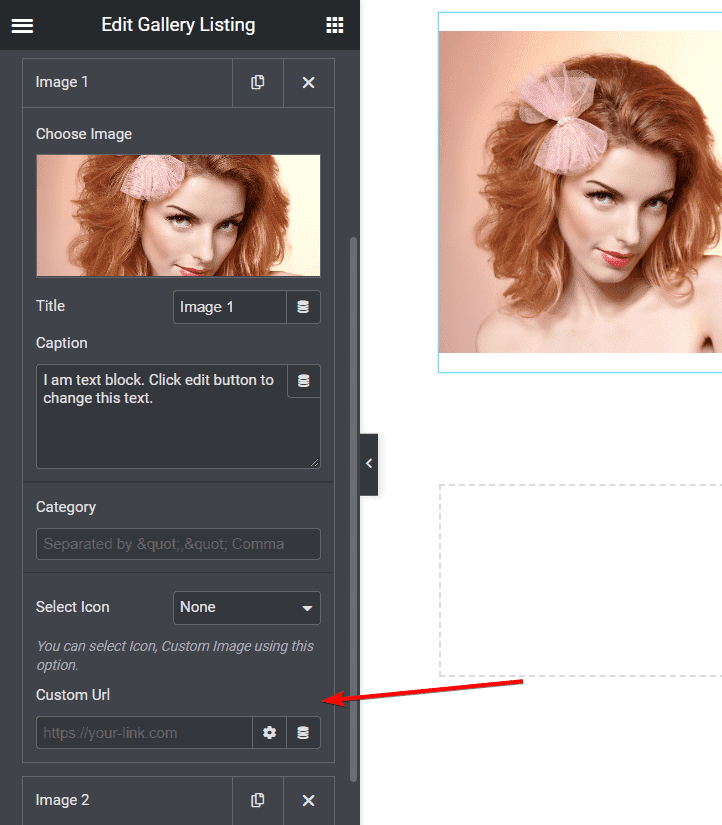
Step 5: Set the custom link for each image
Inside each repeater item you will find fields for image title, description, category (used for filter tabs), hover icon, and Custom Link.
Paste the destination URL into the Custom Link field for that image. Repeat this for every image in your gallery.
Step 6: Choose how the link triggers
In the Style tab, find the Image Box Link toggle. Enable it to make the entire image clickable. If you leave it off, the link only fires when the visitor clicks the icon overlay that appears on hover.
For portfolio sites and product galleries, enabling the full image box link gives the best user experience.
Want to make entire Elementor columns or sections clickable too? Try the free Wrapper Link extension from The Plus Addons for Elementor.
How to Add Custom Links to Each Carousel Image in Elementor
The process for creating a carousel with per-image links is the same as the gallery setup above. The Gallery Listing widget includes Grid, Masonry, Metro, and Carousel Slider layouts.
Switching layouts does not remove the image data or custom links you already entered.
Step 1: Set up your images in Repeater Mode with custom links
Follow steps 1 through 5 from the gallery section above. Add your images using Repeater Mode and assign a custom link to each one before changing the layout.
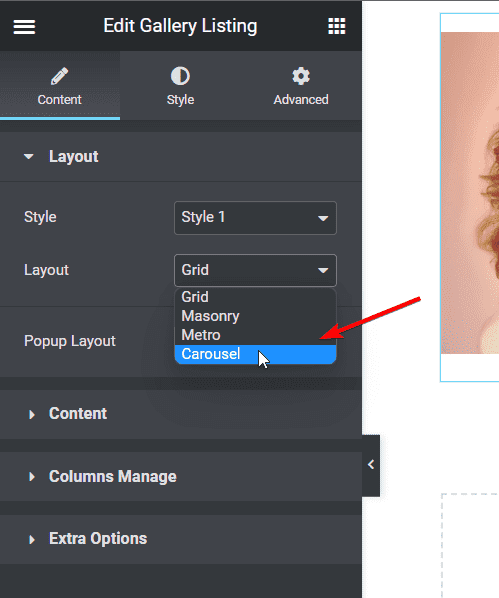
Step 2: Switch the layout to Carousel Slider
In the Content tab, find the Layout option and select Carousel Slider. Your images now display as a scrolling carousel. Each slide retains the custom link, title, and category you set in the repeater.
In the Style tab, configure carousel-specific settings: autoplay speed, loop behavior, slides to show, navigation arrows, and dots.
Because the same widget handles all layouts, you can toggle between Grid, Masonry, Metro, and Carousel at any point without re-entering your image data or links.
A larger DOM size can slow down your Elementor site. Learn what it is and How to Reduce DOM Size in Elementor in this detailed guide.
What Else Can the Gallery Listing Widget Do?
Custom links per image are one feature of the Gallery Listing widget from The Plus Addons for Elementor. Here is what else is included in the Pro version:
| Feature | What It Does |
|---|---|
| Multiple layouts in one widget | Switch between Grid, Masonry, Metro, and Carousel Slider from a single widget with no need to re-add images when switching layouts |
| Repeater and ACF Gallery modes | Add images manually via the repeater, or connect an Advanced Custom Fields gallery field to display images dynamically from posts or custom post types |
| Category-based Ajax filters | Assign each image a category tag; the widget generates filter tabs that sort images on click without reloading the page |
| Hover overlay content | Show image title, description, and a custom icon on hover, useful for portfolio items where each image benefits from a short label |
| Image size normalization | Force all images to the same display dimensions regardless of original file size. Prevents uneven grid cells in layouts with mixed-size photos |
| 3D Parallax and Mouse Parallax | Add depth effects to the image grid. Images shift in response to cursor movement for a premium interactive feel with no JavaScript coding |

Looking to add a mega menu to your Elementor site? Here’s How to Build a Mega Menu on an Elementor WordPress Site.

Is the Gallery Listing Widget the Right Choice for Your Site?
If you need per-image links in an Elementor gallery or image carousel, the Gallery Listing widget from The Plus Addons for Elementor is the most practical no-code option available.
It removes the bulk-upload limitation of Elementor’s native widgets and gives you full control over each image’s link, title, description, and category, all within the standard Elementor drag-and-drop interface.
Best for: Portfolio sites, product image galleries, service showcases, agency client work pages, and any Elementor layout where each image needs to direct visitors to a different destination.
The Gallery Listing widget is available on the free plan. The Repeater Mode and Carousel Slider layout used in this guide both require The Plus Addons for Elementor Pro, starting at $39/year for one site.
The Pro plan also unlocks 120+ widgets, 8 builders, display conditions, and all extras. Elementor Pro is not required. The widget works with Elementor Free.
The free plan includes 35+ widgets to get started. Compare free vs Pro features to see what’s included at each tier.