





Your WordPress footer shows generic text by default. Most themes display “Powered by WordPress” or your theme developer’s name. For any real website, that space should carry your brand name, your copyright year, and your ownership notice instead.
A custom copyright notice does two things: it tells visitors who owns the content, and it removes the “innocent infringer” defense if someone copies your material without permission. A visible copyright notice is your first line of legal protection.
This guide covers five ways to change footer copyright text in WordPress, from no-code options that take two minutes to a drag-and-drop approach for Elementor users. All methods were verified on WordPress 6.9 in May 2026.
What Is Footer Copyright Text in WordPress?
Footer copyright text is the line of text at the bottom of every page on your WordPress site. By default, WordPress displays “Powered by WordPress” or your theme developer’s name. You replace it with your own brand name, copyright year, and ownership statement.
The notice tells visitors that you own the site and its content. Without one, a person who copies your content can claim in a legal dispute that they did not know your work was protected. A visible copyright notice removes that defense entirely.

What Should Your Copyright Notice Include?
Copyright protection is automatic in most countries under the Berne Convention — you own the copyright to your content the moment you create it, with or without a notice. But a visible notice strengthens your position in any dispute and removes the “innocent infringer” defense from anyone who copies your work. A complete copyright notice typically includes these elements:
| Element | Example | Recommended? |
|---|---|---|
| The © symbol or the word “Copyright” | © or Copyright | Yes |
| Year of first publication | 2019 | Yes |
| Date range (if content is updated regularly) | 2019–2026 | Yes |
| Name of the site owner | Your Business Name | Yes |
| “All Rights Reserved” phrase | All Rights Reserved | Optional |
A complete example: © 2019–2026 Your Business Name. All Rights Reserved.

A well-designed footer does more than show copyright text. Here are the top WordPress themes that make footer design easier right out of the box.
How to Change Footer Copyright Text in WordPress [5 Methods]
The right method depends on your theme and how much control you need. Match your situation to the table below before you start:
| Method | Best For | Requires | Difficulty |
|---|---|---|---|
| Theme Settings | Classic themes with built-in footer options (Astra, Kadence, OceanWP) | Nothing extra | Beginner |
| Site Editor | Block themes (Twenty Twenty-Four, Kadence Blocks) | A block theme installed | Beginner |
| Edit footer.php | Any theme, full code control | Child theme | Intermediate |
| Plugin | Any theme, no coding | Remove Footer Credit (free) | Beginner |
| Elementor Footer Builder | Elementor Pro users who want full footer design | Elementor Pro + The Plus Addons Pro | Beginner (visual) |
Method 1: Use Your Theme’s Built-in Footer Settings
Most popular WordPress themes include a dedicated footer copyright field in the WordPress Customizer. This is the fastest method, check here first before installing anything.
Step 1. From the WordPress dashboard, go to Appearance > Customize.
Step 2. Look for a section labeled Footer, Footer Options, Footer Bar, or Footer Copyright in the Customizer sidebar. The exact label depends on your theme. Popular themes like Astra, OceanWP, Kadence, and GeneratePress all include a footer copyright field, but the sub-section name varies between theme versions. If you do not see a footer copyright field here, move to one of the methods below.
Step 3. Enter your copyright notice in the available text field. Include the © symbol, year range, your name, and “All Rights Reserved.”
Step 4. Click Publish to save the change.
If your theme does not have a footer copyright option in the Customizer, move on to one of the methods below.
Method 2: Use the WordPress Site Editor (Block Themes Only)
If your site uses a block theme, such as Twenty Twenty-Three, Twenty Twenty-Four, or Kadence Blocks, you can edit the footer copyright text directly through the WordPress Site Editor without any plugin or code. This method only works when a block theme is active.
To confirm your theme type: if Appearance > Editor appears in your WordPress admin menu, you have a block theme. If you only see Appearance > Customize, you have a classic theme, use Method 1 or Method 4 instead.
Step 1. Go to Appearance > Editor to open the WordPress Site Editor.
Step 2. In the left sidebar, click Patterns.
Step 3. Under Template Parts, select Footer.
Step 4. Click the pencil icon next to your footer template to open it in the block editor.
Step 5. Click on the paragraph or text block that contains the copyright notice and edit the text directly.
Step 6. Click Save to apply the change across your entire site. WordPress will confirm which template parts are being updated, confirm and save.
Method 3: Edit the footer.php File (Developer Method)
Editing footer.php gives you full control over what appears in the footer. However, editing a theme’s files directly through the WordPress Theme File Editor means your changes are overwritten every time the theme updates. The correct approach is to create a child theme first and edit the footer.php inside the child theme instead.
If you need to make a quick edit and understand the risk, the WordPress Theme File Editor is still accessible in WordPress 6.9 at Appearance > Theme File Editor, unless your host or a security plugin has disabled it.
Step 1. From the WordPress dashboard, go to Appearance > Theme File Editor.
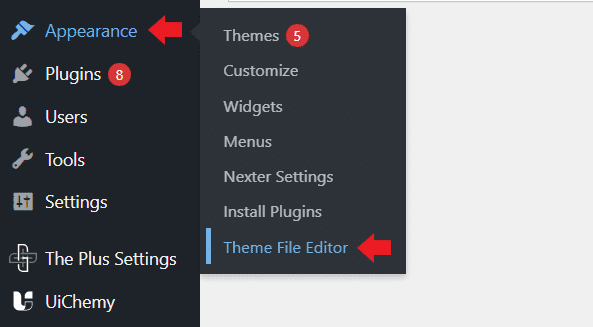
Step 2. Select Theme Footer (footer.php) from the Theme Files list on the right side of the screen.
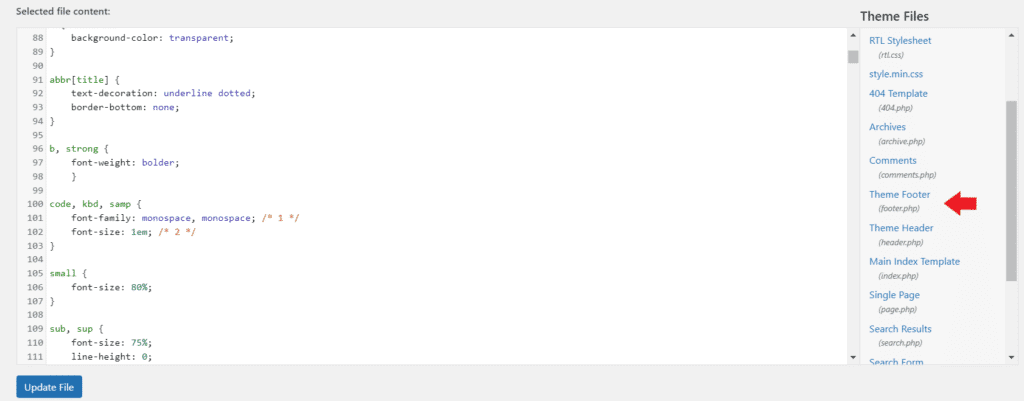
Step 3. Find the line that outputs your current copyright text. Replace it with your custom copyright code:
echo '© ' . date('Y') . ' Your Business Name. All Rights Reserved.';
Step 4. Click Update File to save. Visit your site to confirm the footer text has changed.
Using date('Y') in the code above outputs the current year automatically, so the year updates on its own every January 1.
Method 4: Use a Plugin (Works on Any Theme)
If you want to change the footer copyright text without touching any code, the Remove Footer Credit plugin handles it in a few clicks. It works by replacing a specific text string in the footer before the page loads, so it works on any theme, including themes that lock the footer.php from direct edits.
According to WordPress.org, Remove Footer Credit by WP Chill has 70,000+ active installs, a 4.7 out of 5 star rating, and is tested up to WordPress 6.9.4 (install count verified May 2026).
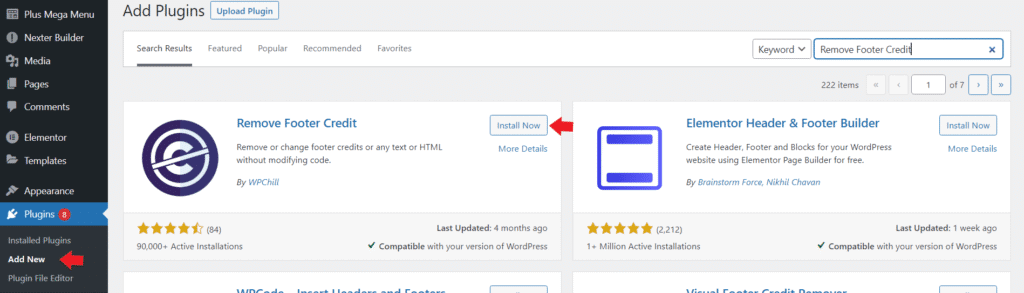
Step 1. Go to Plugins > Add New, search for Remove Footer Credit, install, and activate it.
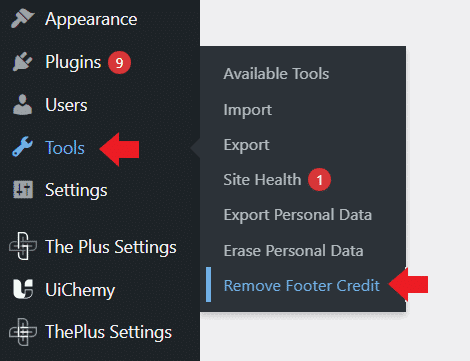
Step 2. After activation, go to Tools > Remove Footer Credit.
Step 3. In the first text box, enter the exact footer text you want to remove, for example: Powered by WordPress. In the second text box, type your replacement, for example: © 2026 Your Business Name. All Rights Reserved.
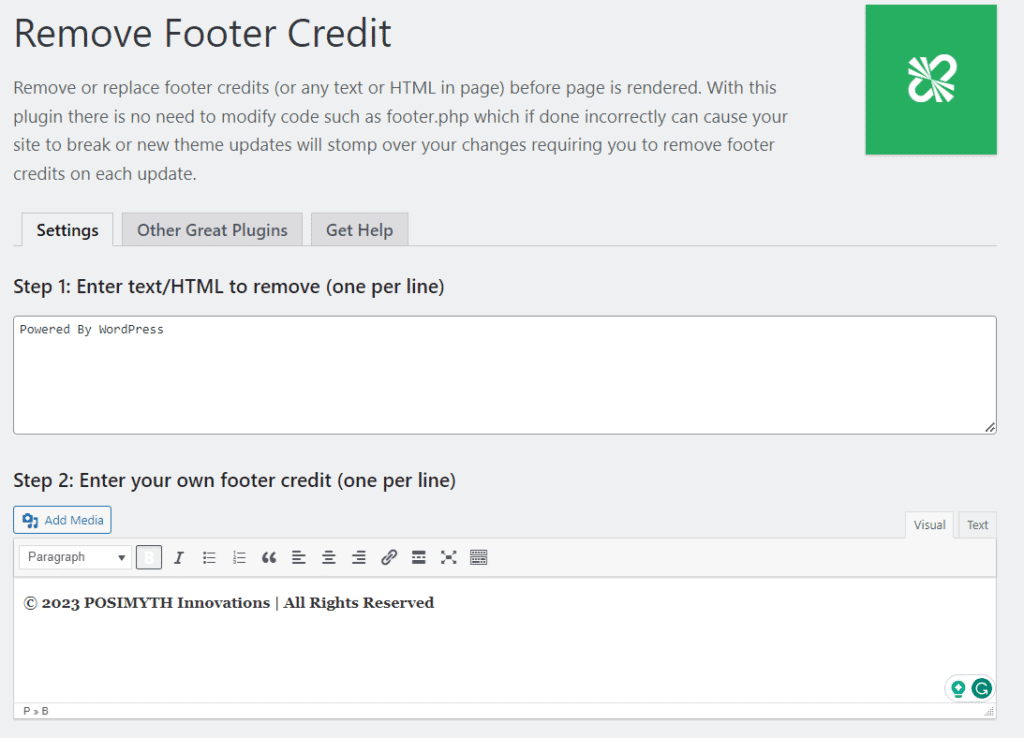
Step 4. Switch to the Text editor tab if you want to add HTML, for example, to set a custom font color or wrap the copyright text in a link.
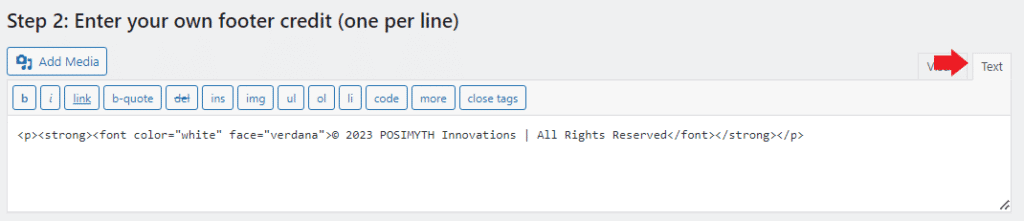
Step 5. Click Save. Reload your site to confirm the new footer copyright text is live.
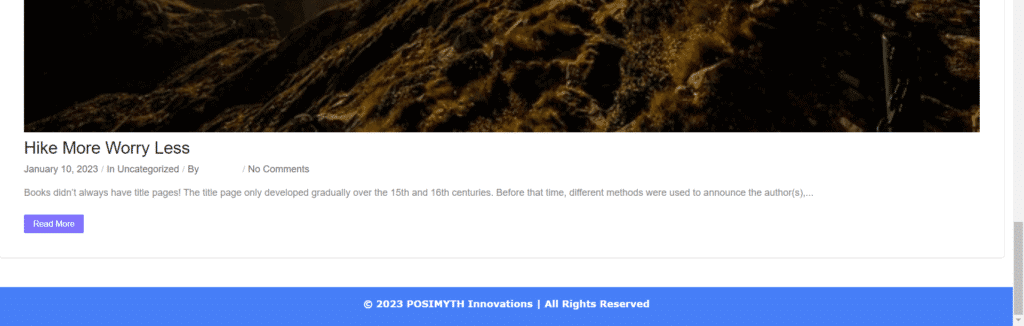
Method 5: Build a Custom Footer with Elementor (Elementor Pro + TPAE)
If your site uses Elementor Pro, you can design a complete custom footer using the Theme Builder, including your copyright text, logo, social icons, and review badges. Theme Builder is a Pro-only feature and is not available in the free version of Elementor.
If you also have The Plus Addons for Elementor (Pro) by POSIMYTH installed, the Footer Builder gives you 12 footer-specific widgets including Footer Text, Social Feed, App Download Button, Review Badge, Marquee Text, and a Mailchimp Newsletter form, so you can build a fully branded footer visually without code. Pro plans start from $39/year.
Step 1. From the WordPress admin, go to Templates > Theme Builder.
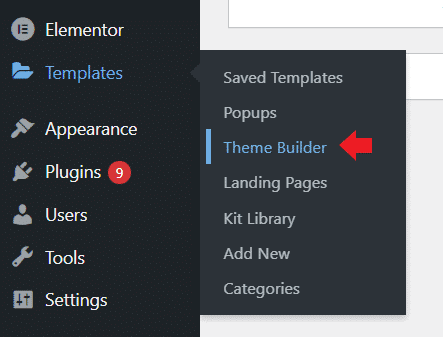 Theme Builder navigation” class=”wp-image-133594″/>
Step 2. In the Theme Builder, select the Footer section and click Add New.
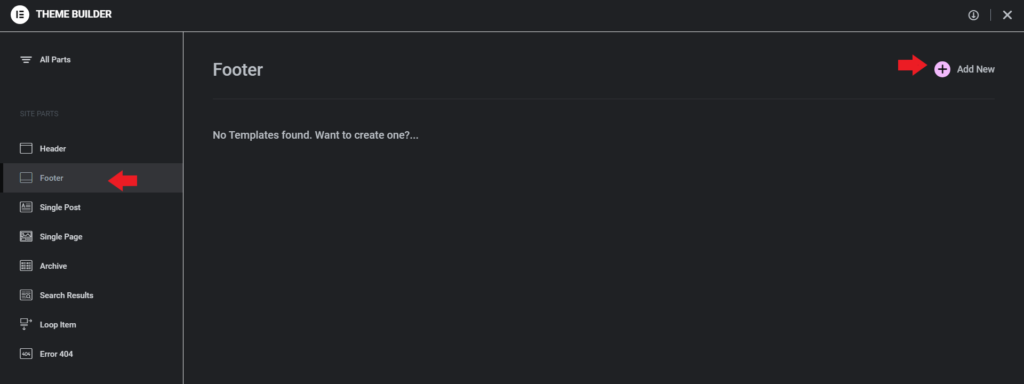
Step 3. Choose a footer template from the library or start from a blank canvas.
Step 4. In the Elementor editor, scroll to the footer area and click on the copyright text block to select it.
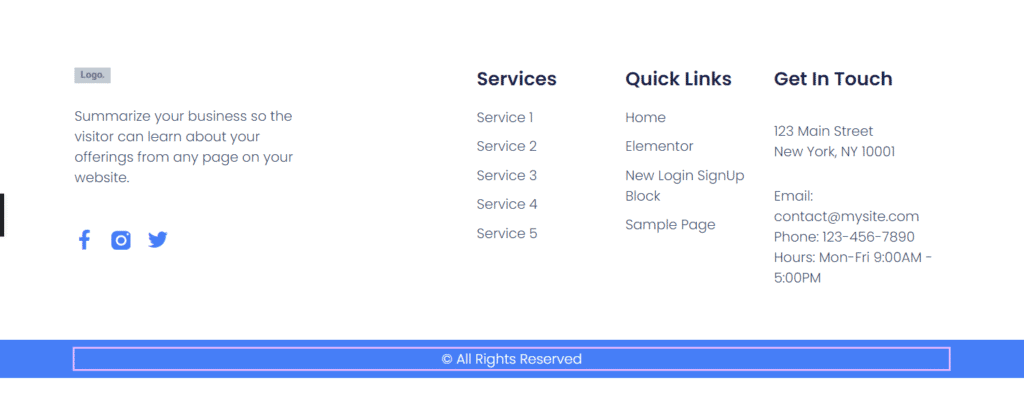
Step 5. In the Content tab on the left panel, find the Text Editor section and type your custom copyright notice.
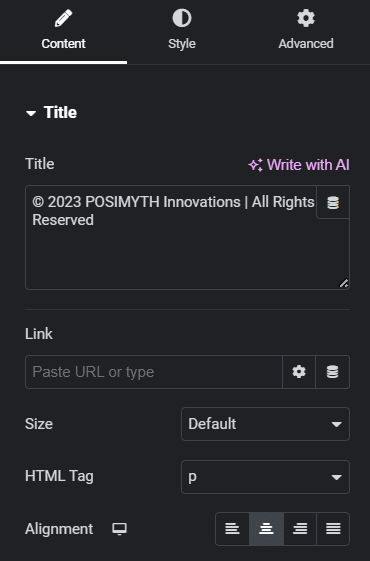
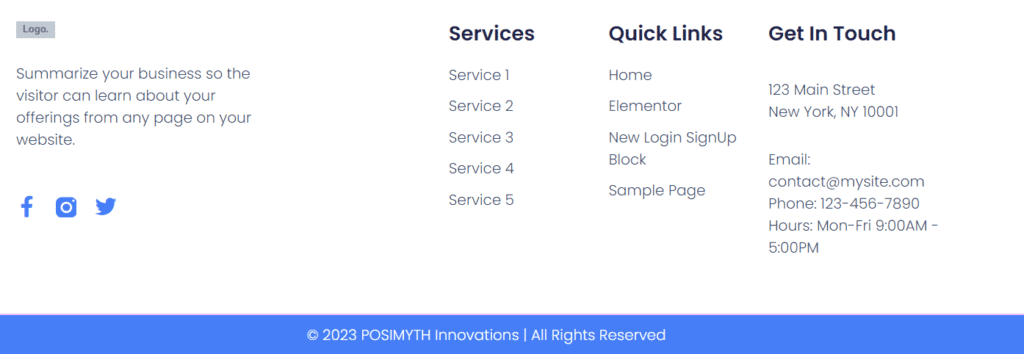
Step 6. Customize the text style under the Style tab, typography, color, and alignment. Then click Publish and set the display conditions so the footer appears across your entire site.
How to Add an Auto-Updating Copyright Year in Elementor
Elementor Pro’s Dynamic Tags feature lets the copyright year update automatically every year, no manual edits needed. Here is how to set it up.
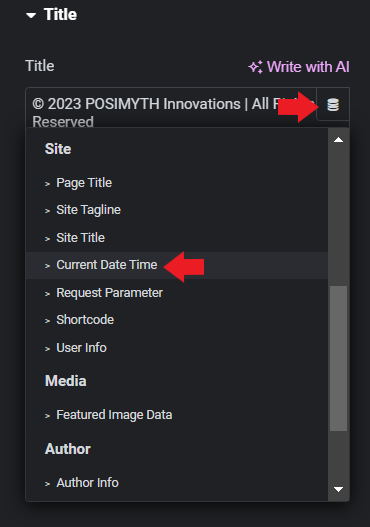
Step 1. In the Text Editor field for your copyright text, click the Dynamic Tags icon (the stack-of-discs icon) and select Current Date & Time.
Step 2. Click the tag to open its settings. Set Date Format to Custom and enter Y as the format, this outputs the current four-digit year only.
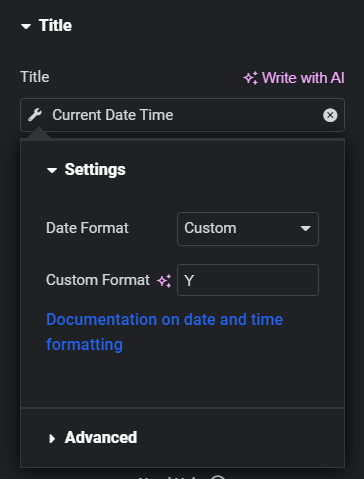
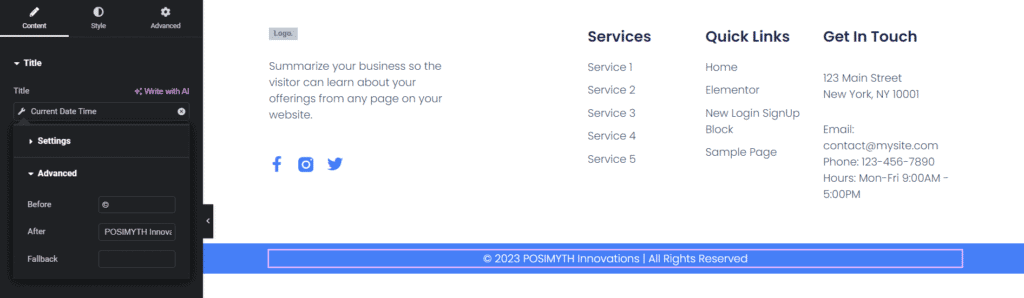
Step 3. Open the Advanced section of the tag settings. In the Before field, add © (with a space). In the After field, add your business name and any additional text. You can also add a URL in the Link field to make the copyright text clickable.
Step 4. Click Publish. The year in your footer now updates automatically on January 1 each year.
Want a fully branded footer beyond just copyright text? The Plus Addons Footer Builder gives Elementor users 12 footer-specific widgets including logo, social feed, review badges, newsletter, and more.
Why Update Your Footer Copyright Text?
Changing the default footer text is not a cosmetic detail. It has practical consequences for your brand, your visitors, and your legal standing.
Intellectual property protection. A copyright notice tells visitors that your content, articles, images, product photos, original writing, is your intellectual property. It signals that you reserve all rights and that unauthorized use is a violation. For any site that publishes original content, this notice is essential.
Professionalism and credibility. Visitors associate “Powered by WordPress” in the footer with a site that is either new, unmanaged, or not taken seriously by its owner. An updated copyright notice with the current year signals that the site is active, owned, and professionally maintained. For business sites, this matters more than most owners realize.
Legal protection in disputes. A copyright notice does not prevent content theft. But it does matter in legal proceedings. If someone copies your content and you have no notice, they can use the “innocent infringer” defense to reduce any damages awarded against them. With a visible copyright notice on your site, that defense is no longer available to them.
Which Footer Copyright Method Should You Use?
The method you choose depends on your theme and how much control you need. Use the table below to match your situation:
| Your Situation | Recommended Method |
|---|---|
| You use Astra, Kadence, OceanWP, or GeneratePress | Method 1: Theme Settings, fastest, no plugins required |
| Your site uses a block theme (Twenty Twenty-Four, etc.) | Method 2: WordPress Site Editor, built in, free |
| You need full code control and are comfortable with PHP | Method 3: Edit footer.php in a child theme |
| Your theme has no footer settings and you want zero coding | Method 4: Remove Footer Credit plugin, free, 70K+ active installs |
| You use Elementor Pro and want a fully designed branded footer | Method 5: Elementor Theme Builder + The Plus Addons Footer Builder |
For most WordPress users, Method 1 takes under two minutes and requires no extra tools. If your theme does not have built-in footer settings, the Remove Footer Credit plugin (Method 4) is the fastest no-code fallback, it works on any theme.
If you are on Elementor Pro and want a fully branded footer with logo, social links, and an auto-updating year, The Plus Addons for Elementor (Pro) gives you 12 footer-specific widgets and a visual drag-and-drop builder. Pro plans start from $39/year, see the full pricing breakdown to compare what each plan includes.