
Last week our team chat lit up with the same question from three different people inside an hour: do we need to add this new Google OKF thing to our sites? Google Cloud had just published the Open Knowledge Format, and the AI-SEO corner of the internet reacted the way it always does to a fresh Google acronym. A little panic, a lot of hot takes, and not much calm explanation.
So here is the calm version. The Open Knowledge Format, or OKF, is real, it is genuinely interesting, and for most WordPress site owners it is not an emergency. This guide covers what OKF actually is, how it relates to the llms.txt file you may already know about, and the one practical thing it should change about how you treat your content.
What you’ll learn: what OKF is and who shipped it, how its Markdown-and-frontmatter structure works, how OKF, llms.txt, and MCP fit together, whether any of this affects your AI visibility right now, and how to get your WordPress content ready for the way AI agents actually read the web.
What Is the Open Knowledge Format (OKF)?
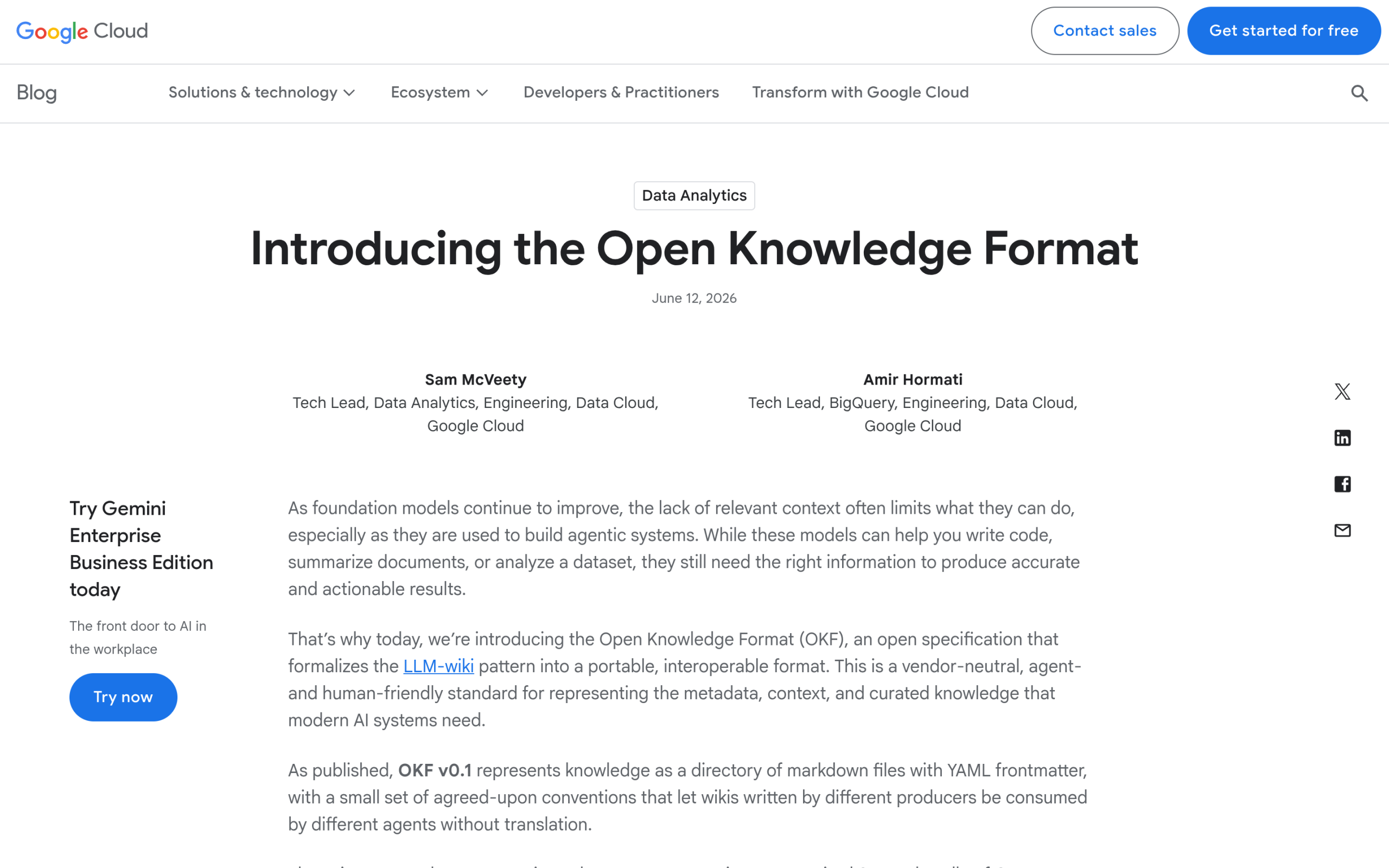
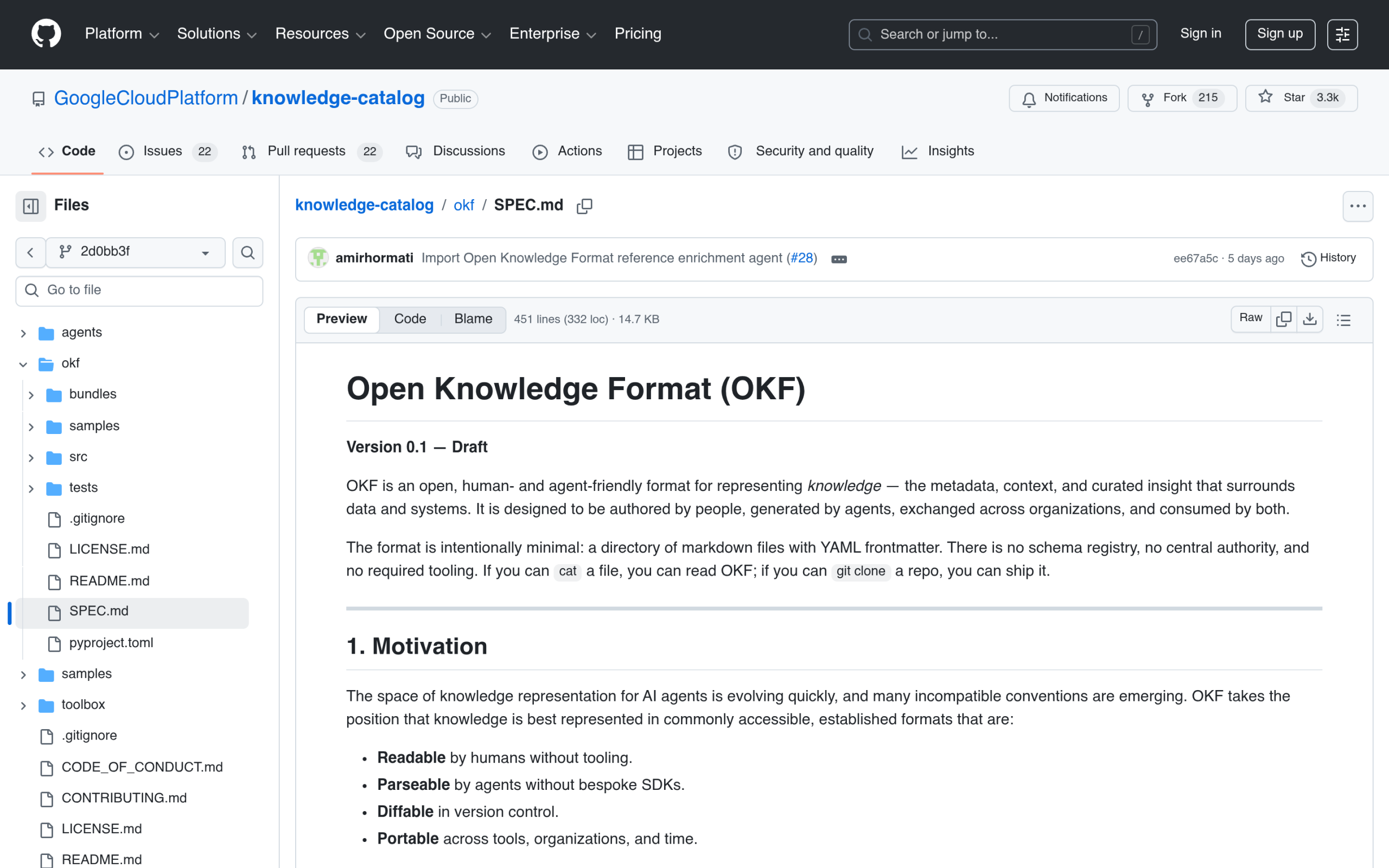
Google Cloud published the Open Knowledge Format on June 13, 2026. In Google’s own words, it is a “vendor-neutral, agent- and human-friendly standard for representing the metadata, context, and curated knowledge that modern AI systems need.” In plainer terms, it is an open way to store knowledge as a folder of Markdown files that both people and AI agents can read, with no proprietary platform or SDK in the middle.
A few things are worth pinning down right away. OKF comes from Google Cloud, not Google Search, and it is aimed at data teams and AI agent builders rather than at bloggers chasing rankings. The specification is short, marked as a version 0.1 draft, and lives in a public GitHub repository. And it is version 0.1, which Google calls “a starting point, not a finished standard.” This is an early, evolving idea, not a finished product you are late to.
How OKF Works: Markdown Plus a Little Structure
An OKF bundle is, at heart, a directory of Markdown files. Each file has a small block of YAML frontmatter at the top, followed by a normal Markdown body. The format keeps the rules deliberately light: the only required field is type. Everything else is optional, including title, description, resource, tags, and timestamp. A bundle can also include an index.md that enumerates the directory contents, so an agent can see what is available before it opens each file.
---
type: Article
title: How to Connect the Ahrefs MCP Server
description: The official MCP servers, why they did not connect, and the fix.
resource: https://yoursite.com/blog/ahrefs-mcp/
tags: [mcp, ahrefs]
---

# How to Connect the Ahrefs MCP Server

The body of the post, as clean Markdown.
The reason this matters is what the agent receives on the other end. Instead of parsing a full HTML page built for browsers, the agent reads plain Markdown written to be machine-friendly. And because a bundle can map its own contents through that index.md file, an agent can see how the documents relate before it reads them, rather than piecing that together from a raw crawl.
OKF vs llms.txt vs MCP: How the Pieces Fit
If you follow AI search, you have met two other acronyms already, and the natural worry is that OKF replaces them. It does not. These standards stack rather than compete, and each does a different job.
| Standard | What it is | Its job |
|---|---|---|
| llms.txt | A signpost file at your site root | Points AI to your priority pages |
| OKF | A bundle of Markdown knowledge files | Hands over the full library of content, mostly internal |
| MCP | A connection protocol | Lets an agent call tools and pull live data |
A useful way to hold it in your head: if an llms.txt file is the signpost at the front door, OKF is the library inside, and the Model Context Protocol is the librarian who fetches things on request. You can adopt one without the others, and most sites today start with the signpost.
Does OKF Change Your AI Visibility Right Now? An Honest Answer
No, not directly, and it is worth being honest about that. OKF was designed for internal organizational knowledge: how a company’s data is structured, how its metrics are defined, how its processes work. That knowledge usually sits scattered across wikis, catalogs, shared drives, and the heads of a few engineers. OKF gives teams a common format to pull it together for their own AI agents.
It is not a Google Search ranking signal, and there is no setting that makes a public site rank higher or get cited more because it ships an OKF bundle. Even people enthusiastic about the format put it bluntly: a bundle will not move your rankings or your AI visibility this week. If you run a WordPress blog or a business site, you do not need to stop what you are doing and build one.
What OKF Signals for WordPress Site Owners
Here is where it gets useful. The format itself matters less than the direction it confirms. llms.txt, OKF, and the Model Context Protocol all point the same way: AI systems want clean, structured, machine-readable versions of your content, with the relationships between pieces kept intact. Markdown over rendered HTML. Explicit structure over guesswork.
That is the same reason llms.txt files and per-post Markdown endpoints already exist on the public web. OKF is Google putting an official, well-documented stamp on a pattern that has been taking shape across the AI ecosystem. Reading it as “one more file to add” misses the point. Reading it as “this is how machines will consume my content” gets you ready for what comes next, whether or not you ever publish a bundle. The same shift is behind the rise of answer engine optimization.
How to Get Your WordPress Content AI-Ready Today
You can act on the OKF signal without writing a single YAML file. The goal is simple: make sure machines can read your content cleanly and understand how it fits together. Four steps cover most of it.
- Give AI a clean Markdown version of each post, so an agent never has to fight your theme to read it.
- Publish an llms.txt and an llms-full.txt so AI tools can find your priority content.
- Add structured data such as Article, Speakable, FAQPage, HowTo, and ItemList so machines understand what each page is.
- Measure how ready your content actually is, rather than guessing.
This is the gap a tool like RankReady is built to close on WordPress. It lets you add .md to any post URL to get a clean Markdown version with the right Content-Type, generates both your /llms.txt and /llms-full.txt and keeps them current as you publish, and outputs Article, Speakable, FAQPage, HowTo, and ItemList schema. It then scores every post from 0 to 100 on schema, freshness, content depth, and author signals, and shows a live log of which AI crawlers, including GPTBot, ClaudeBot, and PerplexityBot, actually fetched your pages.
RankReady is free, released under the GPL-2.0 license, runs on WordPress 6.0 and PHP 7.4 or higher, and works alongside Rank Math, Yoast, AIOSEO, and SEOPress rather than replacing them. If OKF made you wonder whether your content is machine-readable, this is a direct way to find out and fix it.
The Practical Takeaway
OKF is a well-designed answer to a real enterprise problem, and a clear signal about where AI content consumption is heading. You do not need to build an OKF bundle this week, and anyone telling you to panic is selling something. What you do need is content that machines can read cleanly: a Markdown version, an llms.txt, solid schema, and a way to check your work. Get those basics right and you are already aligned with the direction OKF represents.
Suggested Reading
- What Is an llms.txt File and How to Add One in WordPress
- What Is an MCP Server? The WordPress Guide to Model Context Protocol
- What Is Answer Engine Optimization (AEO)? A WordPress Guide
- Schema Markup Generator for WordPress: The Free Ways to Do It
- How to Get ChatGPT Citations to Your WordPress Content
- How Google’s Knowledge Graph Works (and How to Get Into It)