
A few headlines have called Google’s Open Knowledge Format the Markdown standard that could replace your wiki. If you run a content or knowledge team, that is the kind of claim that makes you stop scrolling.
So let me give you the honest version: OKF is genuinely interesting, but it is not going to replace your wiki this year, or probably next. What it will do is reshape how the knowledge inside that wiki gets shared with AI. Here is the difference, and why it still matters for your team.
What you’ll learn: what OKF actually does compared to a wiki, why replace is the wrong word, and what content and knowledge teams should take from it, including anyone running a public site.
The Headline vs the Reality
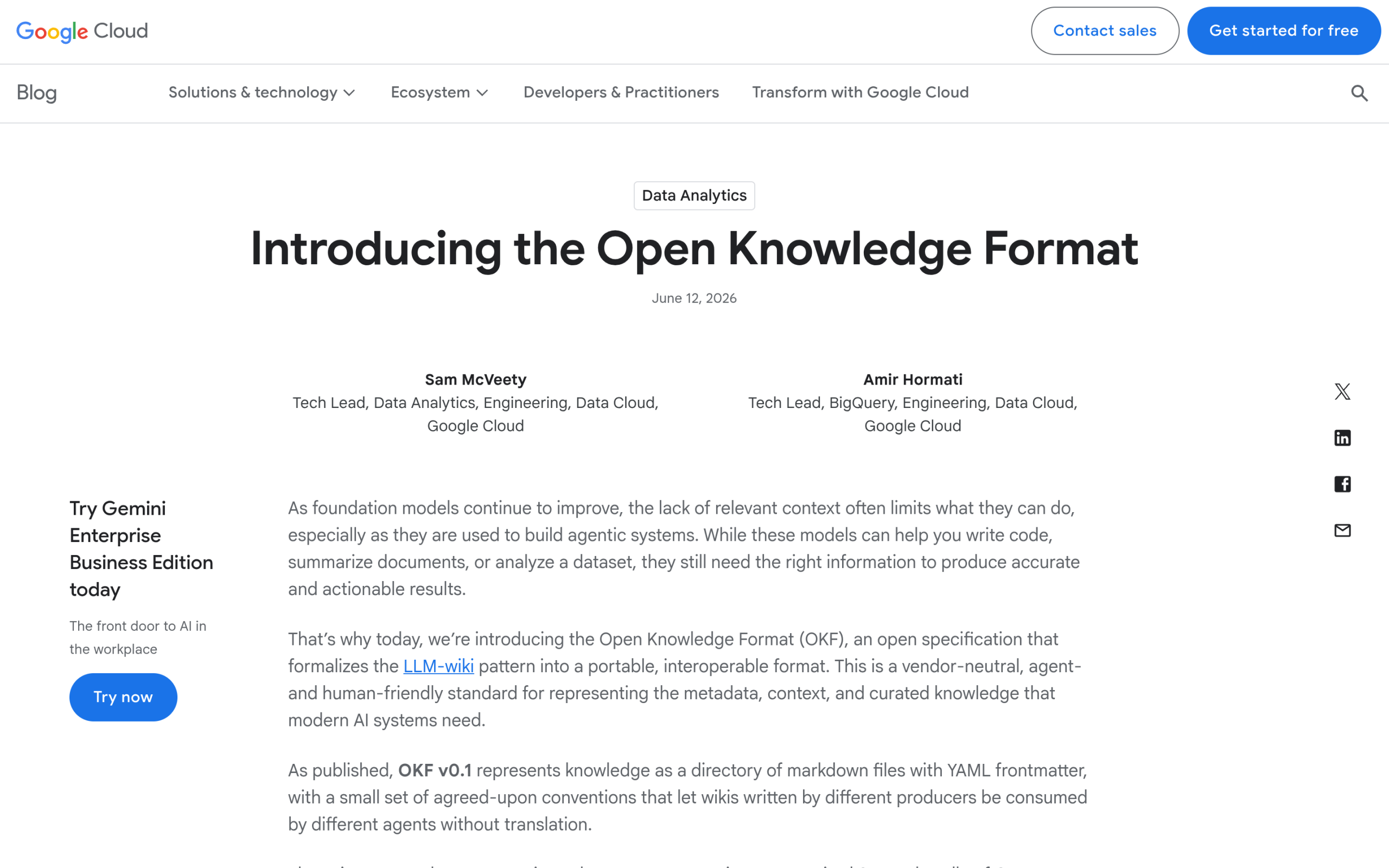
Some of the coverage frames OKF as a wiki-killer. The reality is more modest. OKF is version 0.1, a format for representing knowledge as a directory of Markdown files that AI agents can read, with no required tooling.
That last part matters: a wiki is not just its content. It is the editing interface, the permissions, the search, the version history, and the day-to-day collaboration. OKF provides none of that.
It is better understood as a portable way to export and exchange knowledge than as a replacement for the place your team actually works.
What OKF Actually Does, Compared to a Wiki
| A wiki | OKF | |
|---|---|---|
| Main purpose | Human collaboration and editing | Machine-readable knowledge for AI agents |
| Format | Platform-specific pages | Markdown files with YAML frontmatter |
| Audience | People | AI agents, and humans |
| Editing, permissions, search | Built in | Not part of the spec |
Seen this way, OKF and your wiki are not competitors. Your wiki is where people create and maintain knowledge. OKF is one way to hand a clean copy of that knowledge to an AI agent. Our full OKF guide covers the format in detail.
Why Content and Knowledge Teams Should Care
Even though OKF will not replace your wiki, it points at where knowledge management is heading: toward knowledge that AI agents can consume without a custom integration for every system.
Teams that already keep clean, well-structured, Markdown-friendly documentation will adapt to this with almost no effort. Teams whose knowledge is locked in screenshots, PDFs, and tribal memory will feel the friction.
The same instinct runs through the broader AI-readiness stack: structure your knowledge so a machine can use it.
What It Means for Your Public Website
OKF is aimed at internal knowledge, but the lesson carries straight over to a public WordPress site. Machines want clean Markdown and clear structure, whether the content lives in an internal bundle or on your blog.
You do not need to build an OKF bundle to benefit. You need your public content to be readable in the same way, which is the same point we made in Markdown is becoming the language of AI agents and in OKF vs llms.txt.
Where RankReady Fits
On the public-web side, RankReady gives your WordPress content the same kind of machine readability OKF brings to internal knowledge.
It adds a clean Markdown version to any post, generates your llms.txt, outputs schema, and scores each post for AI readiness, so the knowledge on your site is easy for an agent to read.
It is a soft fit here rather than the headline, but if the wiki conversation made you think about machine-readable knowledge, this is the public-site version of that idea. RankReady is free, GPL-2.0, and works alongside Rank Math, Yoast, AIOSEO, and SEOPress.
The Bottom Line
OKF reshapes how teams share knowledge with AI; it does not replace the wiki where that knowledge is made.
Keep your wiki, keep your documentation clean and structured, and treat OKF as a portable bridge to AI agents rather than a migration you have to rush. Replace is the wrong word. Ready is the right one.