


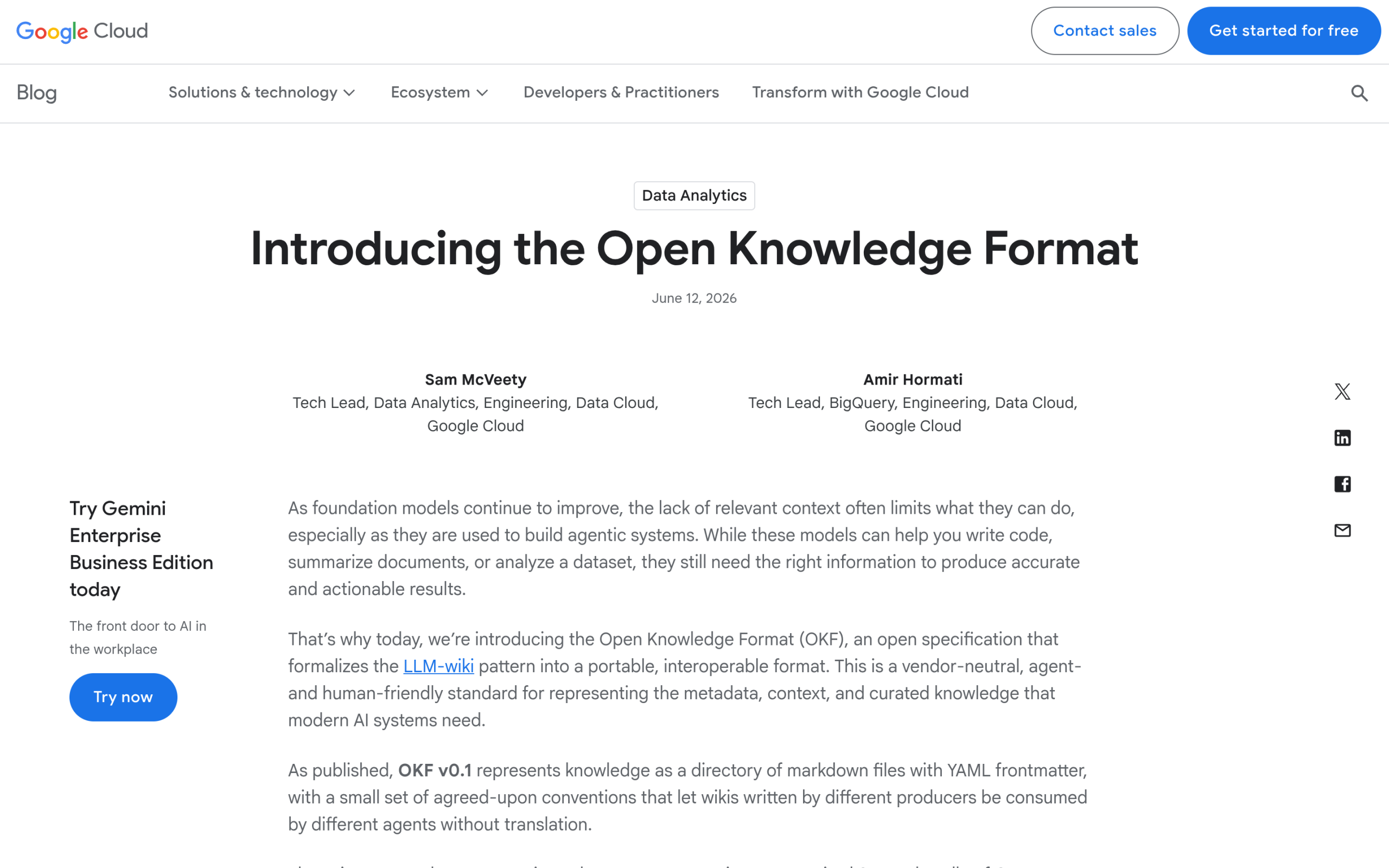
If you do SEO or content marketing, you have probably seen Google’s Open Knowledge Format scroll past and filed it under things for the data team. Half right. OKF did come from Google Cloud’s data side, and most of the explainers are written for engineers.
But the idea underneath it is squarely a marketing concern, and it is worth two minutes of your time. Here is OKF in plain marketing language, without the data-engineering vocabulary.
What you’ll learn: what OKF is in one marketer-friendly sentence, why it keeps surfacing in SEO conversations, and what an SEO or content marketer should actually do about it.
OKF in One Sentence (for Marketers)
OKF is a standard way to package your knowledge as plain Markdown files so AI agents can read it, a bit like a style guide for handing your content to machines.
It came out of Google Cloud, which is why it sounds like a data-team project, but the principle, make your knowledge clean and machine-readable, is the same thing SEOs have been inching toward with structured data and content hygiene for years.
Our full OKF guide has the technical detail if you want it.
Why It Keeps Showing Up in SEO Conversations
OKF landed in the same wave as llms.txt, AI Overviews, and answer engines, so it gets swept into the same conversation. A marketer sees Google plus AI plus a content format and reasonably assumes it is a new ranking lever.
It is not, and we said so plainly in does OKF matter for WordPress SEO and in our AI SEO myths guide.
But the theme underneath it, structuring content so machines can use it, is absolutely a marketing and answer-engine concern, which is why it belongs on your radar even though it is not on your task list.
The Marketer’s Translation
| What the docs say | What it means for you |
|---|---|
| Knowledge bundle | Your content library, packaged so AI can read it |
| YAML frontmatter | Metadata and tags describing each piece of content |
| Agent-readable | An AI can actually understand and use your content |
| Vendor-neutral, interoperable | Not locked to one platform or tool |
What SEOs and Marketers Should Actually Do
- Do not build an OKF bundle for a public blog. It is not a ranking lever and will not move your AI visibility.
- Do internalize the principle: clean structure, Markdown, and schema make your content machine-usable, the core of the AI-readiness stack and of Markdown becoming the language of AI agents.
- Do measure whether AI tools actually fetch and reference your content, so your effort follows the data.
Where RankReady Fits
OKF is the data team’s version of an idea marketers can use right now on the public web.
RankReady brings that idea to WordPress without any engineering: it generates your llms.txt, adds a clean Markdown version of every post, outputs schema, scores each post for AI readiness, and logs which AI crawlers actually fetch your pages.
It is the marketer-friendly way to act on the same principle OKF is built around. RankReady is free, GPL-2.0, and works alongside Rank Math, Yoast, AIOSEO, and SEOPress.
The Bottom Line
OKF is a data-team format with a marketing lesson tucked inside it.
You do not need to adopt the format, but you should absorb the message: the brands that win in AI search are the ones whose content is clean, structured, and easy for a machine to read.
Translate that into your content workflow and you are doing the part of OKF that actually matters for marketing.