






Search “elementor forms conditional logic” and you will find a mix of half-answers. Some guides talk about hiding a whole section on a page. Others quietly assume you are using Gravity Forms or WPForms, not Elementor’s own Form widget. If you build with The Plus Addons for Elementor and you just want a field to show up only when a visitor picks a certain option, this is the straight answer: what conditional logic actually means, what the Form Builder can and cannot do today, and the real way to get show-or-hide behavior on a WordPress form right now.
This matters more than it sounds. A form with too many visible fields at once feels like a chore, and visitors abandon it partway through. A form that only shows what is relevant to the choice a visitor just made feels shorter, even when it asks the same number of questions overall. Getting show-or-hide right on a WordPress form is a conversion decision, not only a technical one.
No fluff, no pretending a feature exists when it does not. Just a clear path from “I want field A to appear only after field B is answered” to a form that actually does that.
What “Conditional Logic” Actually Means on a Form
Conditional logic on a form is a rule that changes what a visitor sees based on what they already typed or selected. Pick “Business” in a dropdown and a company name field appears. Pick “Personal” and it stays hidden. Check a box for “I need a callback” and a phone number field shows up right below it.
This is a field-level rule. It lives inside a single form and reacts the moment a visitor interacts with one specific field. That is different from a page-level rule, which decides whether an entire widget, section, or page is shown to a visitor at all, based on things like their login status, device, or the URL they arrived from. Both are useful. They solve different problems, and mixing them up is where most of the confusion around this keyword starts.
Does The Plus Addons Form Builder Support Field-Level Conditional Logic?
Honestly, not yet. The Form Builder for Elementor in The Plus Addons gives you 12+ field types, required toggles, custom button styling, honeypot and reCAPTCHA spam protection, submission redirects, and email notifications on submit. What it does not currently offer is a native rule that shows or hides one form field based on the answer typed into another field inside that same form. If you have gone looking for that toggle in the Form widget’s Content tab and could not find it, you were not missing anything. It is not there.
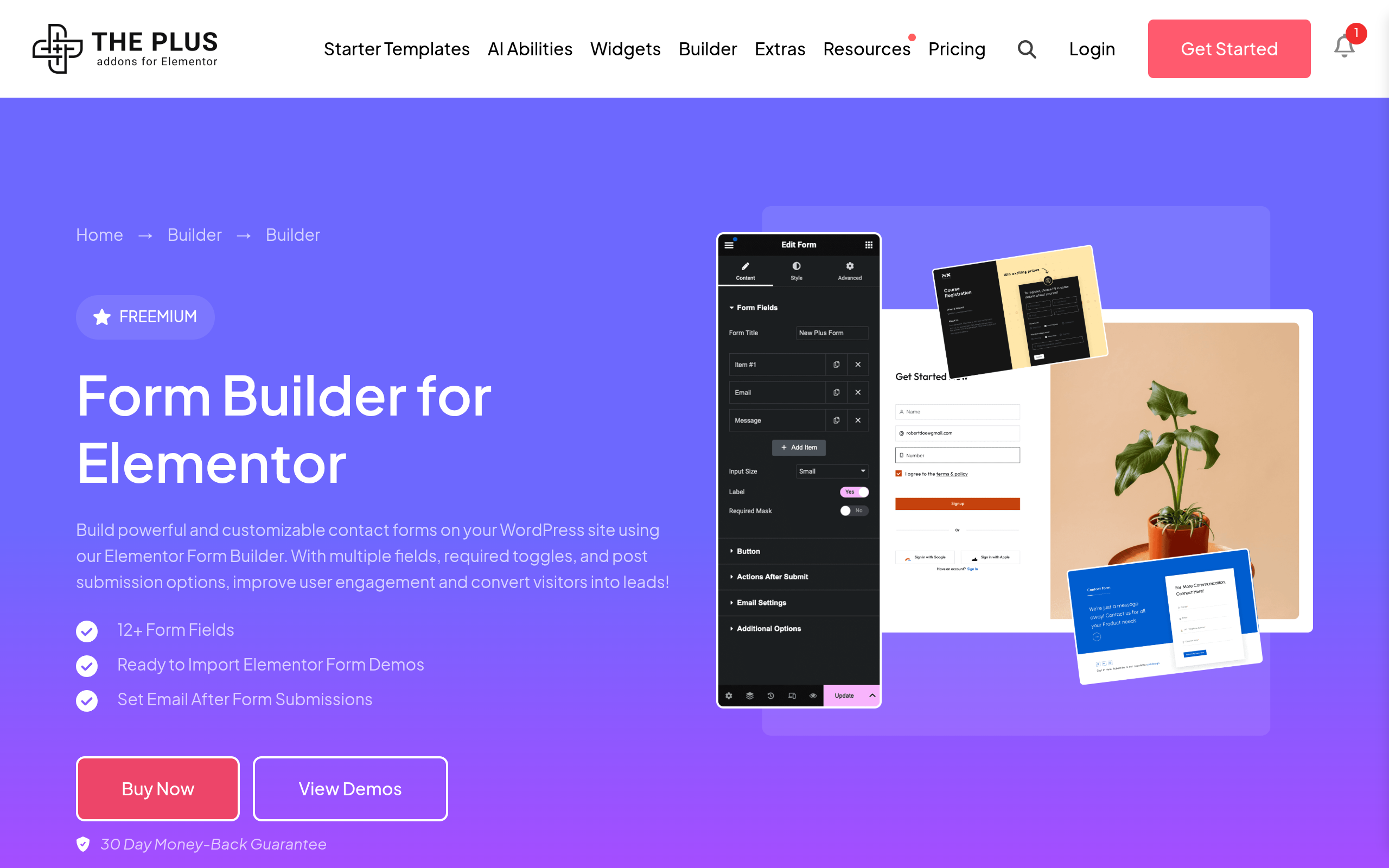
That is a real, current gap, not a reason to close the tab. Gravity Forms and WPForms both built this into their own form widgets years ago, and if you specifically need branching logic inside one form, on a single field, one of those may genuinely fit the job better today. It would be dishonest to write around that. But if you are already using The Plus Addons Form Builder for everything else on your site, there is still a practical way to get show-or-hide behavior around your form, and it comes from a different part of the plugin.
Also Read: 5 Best Elementor Form Builder Plugins Compared
The Real Way to Show or Hide Content Around Your Form: Display Conditions
The Plus Addons ships a separate extension called Display Conditions. Instead of reacting to another field inside the same form, it controls whether an entire Elementor widget, column, or section is shown at all, based on rules you set once in the editor. It supports over 48 condition types across visitor device, login status, date and time, language, URL parameters, single pages and archives, shortcode output, and even ACF or JetEngine custom field values.
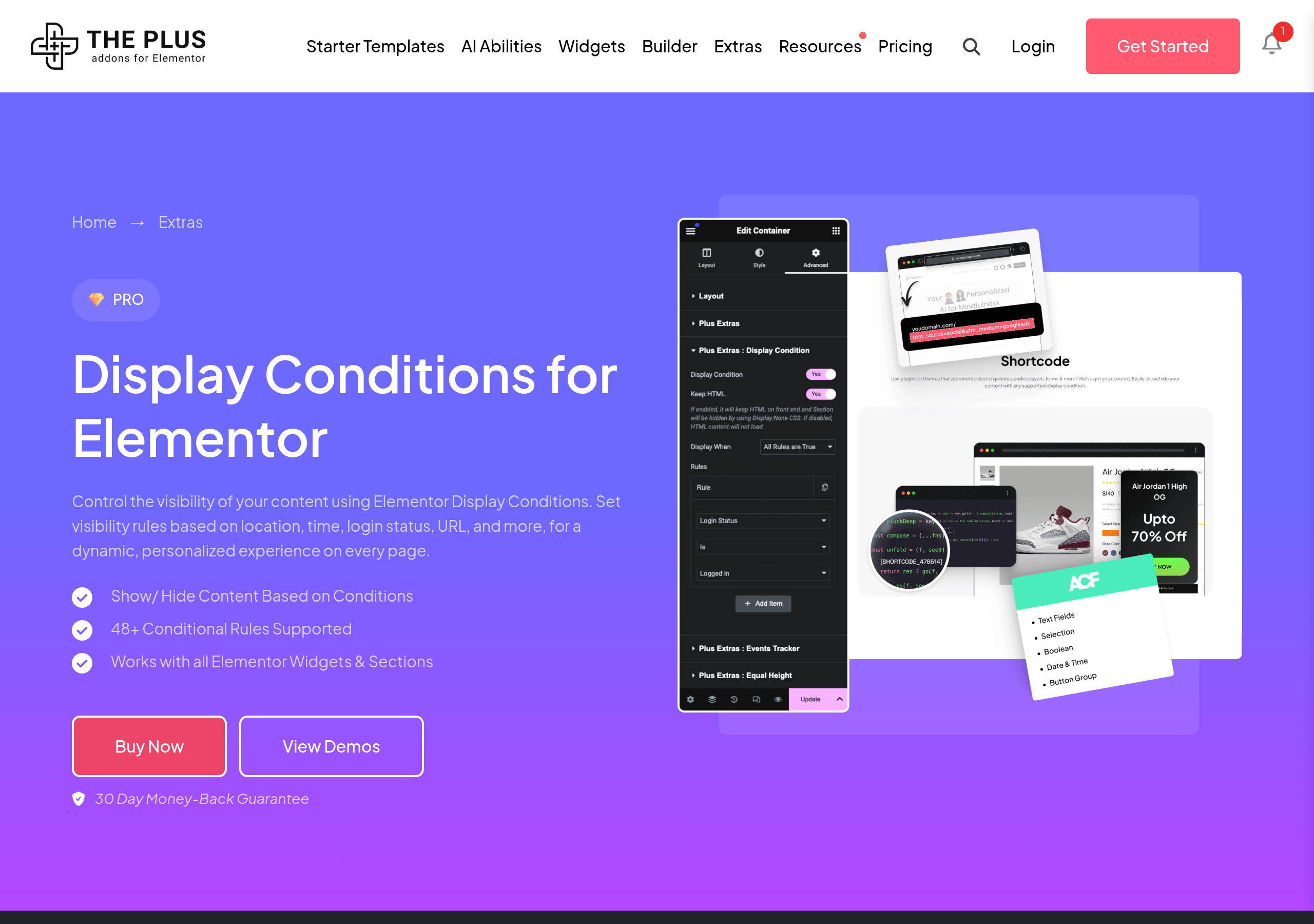
Here is how that maps onto a form in practice. Instead of hiding a single field inside the form, you build two versions of the section around it, a “Business” column with a company name field and a “Personal” column without one, and you use Display Conditions to show only the relevant column based on an ACF or URL-based value. For a callback checkbox, you place the phone field in its own container and set a Display Condition tied to a custom field written by a small script when the box is checked. It is a container-level workaround for a field-level need, and it takes a few extra minutes to set up compared to a native toggle, but it works today, on the plugin you already have installed.
Setting Up a Display Condition Step by Step
Here is the basic setup for showing or hiding a container around a form field using Display Conditions.
- Install and activate The Plus Addons for Elementor, then make sure the Display Conditions extension is turned on under Elementor > The Plus Settings > Extensions.
- Wrap the field you want to control in its own Elementor container or column, separate from the rest of the form.
- Select that container, open the Advanced tab, and scroll to the Display Conditions panel.
- Click Add New Condition and pick a rule category, for example Advanced Custom Fields, URL, or Login Status, depending on what should trigger the field.
- Set the condition value, for example “equals” a specific ACF field value, then save.
- Preview the page in two states (condition met and not met) to confirm the container appears and disappears as expected before publishing.
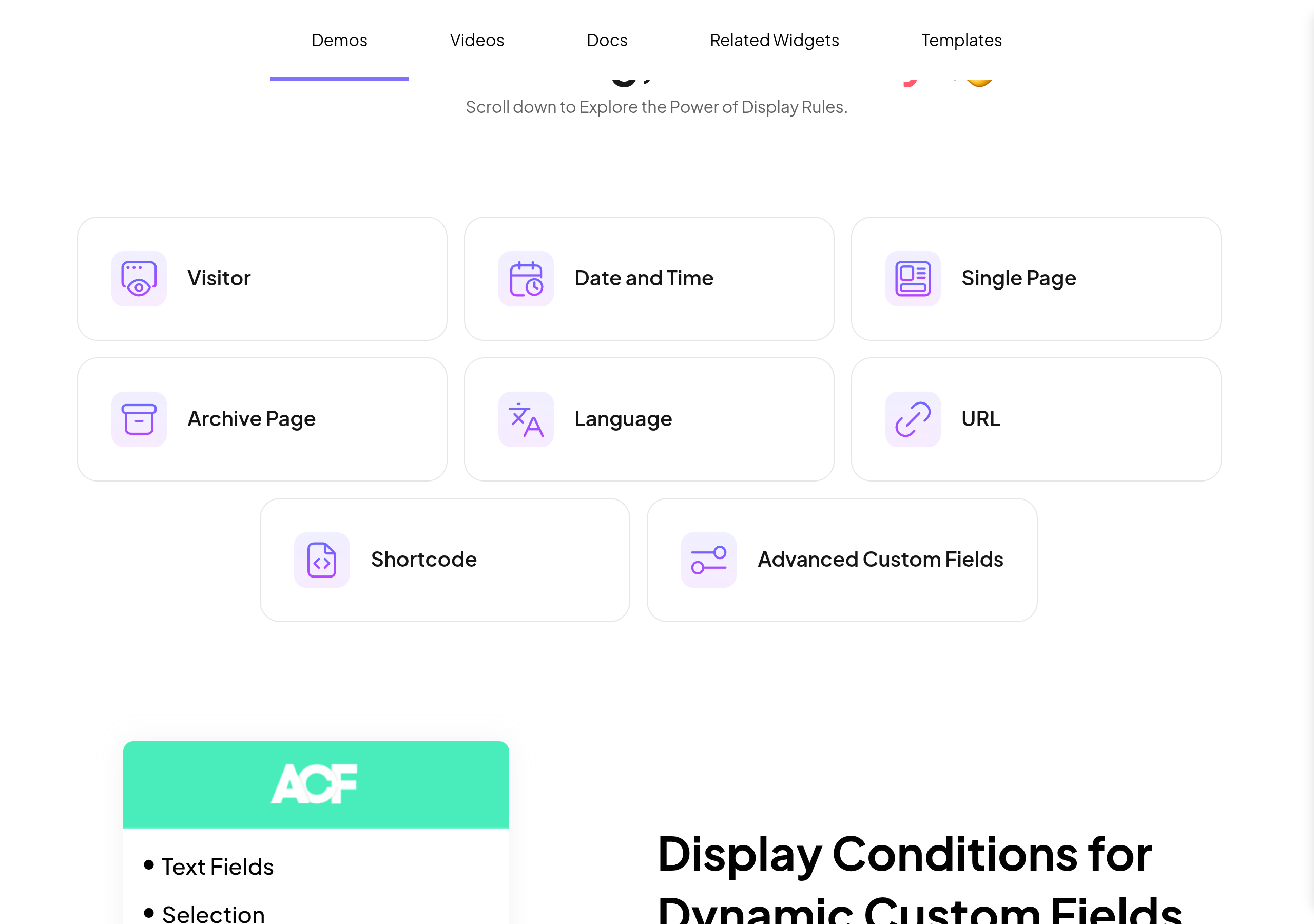
If your trigger is a custom field rather than a URL or login state, pair this with the dedicated Custom Fields Display Conditions extension, which reads values from ACF, JetEngine, MetaBox, and Toolset directly, so you are not stuck writing your own PHP to bridge the gap.
Also Read: How to Add reCAPTCHA to an Elementor Form
Common Use Cases for Show-or-Hide Forms
A few patterns come up again and again once you start building forms that adapt to the visitor.
- Business vs. personal signup: show a company name and VAT number container only on the business path, keep the personal path short.
- Service selection: show a container with extra fields (property size, preferred date) only after a specific service is chosen elsewhere on the page.
- Returning visitor shortcuts: hide fields you can already infer from a logged-in user’s profile, and show them only to logged-out visitors, using the Login Status condition.
- Geo or language targeting: show a region-specific field, like a state or province selector, only for visitors from countries where it applies, using the URL or Language condition.
None of these require a form plugin with native branching if you are comfortable structuring the page in containers first. The tradeoff is setup time, not capability.
When You Actually Need True Field-Level Branching
There is one case where the container workaround genuinely falls short: multi-step branching inside a single long form, where dozens of fields need to react instantly to each other without a page reload or a custom field round trip. Quote calculators, insurance intake forms, and long multi-page surveys with real skip logic usually need a form plugin built specifically for that job. If that is your situation, it is worth knowing upfront rather than fighting a container-based workaround for a use case it was not built for.
For the far more common case, a handful of fields that should appear or disappear based on a clear yes/no or dropdown choice, Display Conditions on a container gets you there without adding another plugin to your stack.
Troubleshooting: Why Your Container Isn’t Showing or Hiding
A Display Condition that does not fire is almost always one of four things, in order of how often each one actually happens.
- The condition is on the wrong element. Double check you applied it to the container wrapping the field, not to the field widget itself or a parent section several levels up.
- Caching is serving an old version of the page. Page and object caching plugins can freeze a rendered page before the condition ever gets evaluated. Clear the page cache, then test again in an incognito window.
- The custom field value does not match exactly. A Display Condition set to “equals” is case sensitive and whitespace sensitive. If the ACF field stores “Business ” with a trailing space, a rule looking for “Business” will not match.
- The Display Conditions extension is not enabled. It ships with The Plus Addons but needs to be switched on once under Elementor > The Plus Settings > Extensions before it will appear in the Advanced tab at all.
If you have checked all four and the container still will not cooperate, preview the page as a logged-out visitor in a private browser window. A condition can behave correctly for logged-out traffic but look “broken” while you are testing it logged in as an administrator, simply because an admin-only caching exclusion or a login-status rule is working exactly as designed.
Suggested Reading
- 5 Best Elementor Form Builder Plugins Compared
- How to Add reCAPTCHA to an Elementor Form
- Display Conditions for Elementor
Frequently Asked Questions
Does Elementor’s own Form widget support conditional logic?
Not natively. Elementor Pro’s core Form widget does not include a built-in rule to show or hide one field based on another field’s answer. Third-party form plugins like Gravity Forms and WPForms have this feature in their own widgets.
Can I show or hide a field in The Plus Addons Form Builder based on another field?
Not directly inside the Form widget itself today. The practical workaround is to place the field in its own container and control that container’s visibility with the Display Conditions extension, which ships with The Plus Addons for Elementor.
What is the difference between Display Conditions and form conditional logic?
Form conditional logic reacts to another field inside the same form, instantly, without a page reload. Display Conditions controls whether an entire widget, column, or section is shown at all, based on rules like login status, device, URL, or a custom field value. You can combine them by wrapping a form field in a container and applying a Display Condition to that container.
Do I need a custom field plugin like ACF for Display Conditions to work?
Only if your trigger depends on a custom field value. Many common triggers, like login status, device, date and time, language, or URL parameters, work without ACF. For custom field based rules, The Plus Addons’ Custom Fields Display Conditions extension supports ACF, JetEngine, MetaBox, and Toolset.
Will The Plus Addons add native field-level conditional logic to its Form Builder?
There is no confirmed release date for that feature as of this writing. If your project depends specifically on instant, native field-to-field branching inside one form, evaluate a dedicated form plugin with that feature built in rather than waiting on a roadmap item.